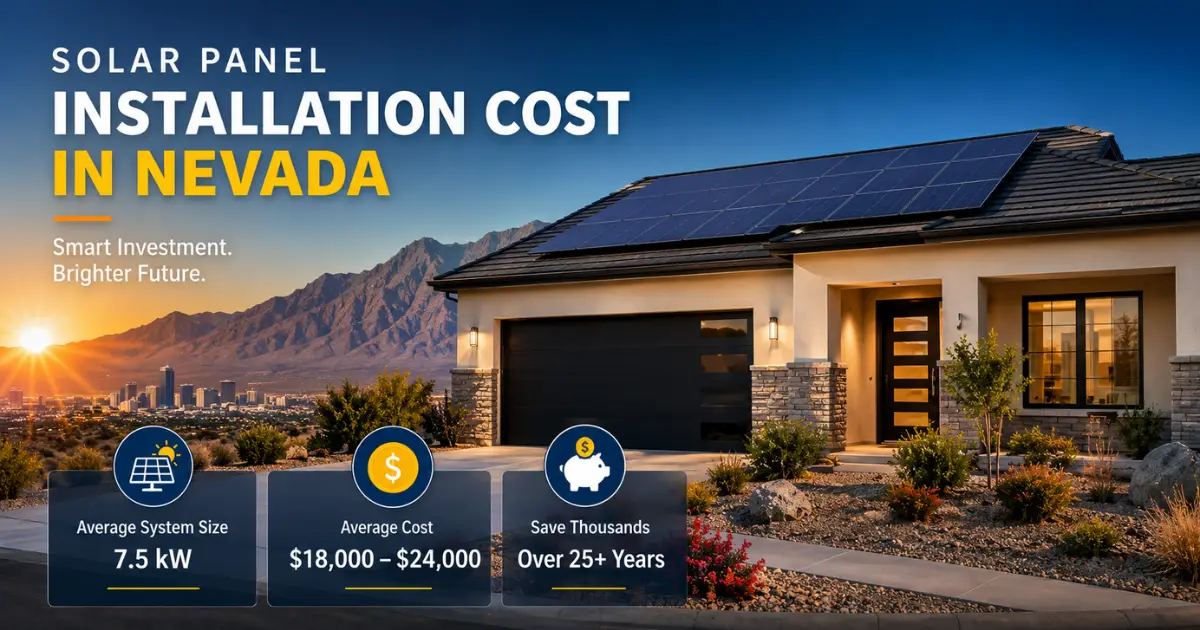
Solar panel installation cost in Nevada averages $2.34 per watt in 2026. Among the three cheapest states in the country, behind only Arizona and New Mexico. That figure covers panels, inverter, racking, and labor, but not permits or NV Energy’s interconnection fee, which factor into your real out-of-pocket total.
Pricing here varies more than people expect by county, system size, and financing choice. This guide breaks down exactly where your money goes, what a fair Nevada quote should include, and how to avoid overpaying.
Key Takeaways
- Cost split: 55% equipment, 30% labor, 15% permits/interconnection.
- Size vs. price: A 10 kW system costs about 1.7x a 5-KW system, not 2x fixed costs don’t scale with panel count.
- Sun, not just price, sets your county apart: Las Vegas-area systems get 6.0–6.5 peak sun hours daily. Reno-area systems get 5.0–5.3 – a 15% production gap that stretches payback time up north.
- Quote checklist: A fair quote itemizes panels, labor, permits, and interconnection separately not bundled.
- Financing gap: run 5–8% APR, without the expired ITC softening the loan principal, that interest adds up faster than it did a year ago, making cash purchases ($13,000–$20,000 upfront) the stronger long-term play if you can afford it.
Nevada Solar Cost by System Size
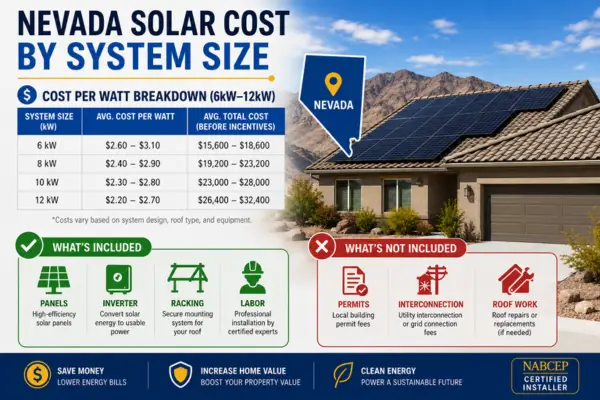
As of July 2026, Nevada solar systems average $2.34 per watt installed, ranging from about $15,000 for a 6 kW setup to $28,666 for a 12.25 kW system Nevada’s average size. Larger solar systems cost less per watt, since fixed costs like permits and labor stay roughly the same regardless of system size.
Cost per Watt Breakdown (6 kW–12 kW)
Bigger solar systems don’t cost proportionally more in Nevada. The reason comes down to fixed costs. Solar Permits, labor mobilization, and inverter installation cost roughly the same whether you’re putting up 15 panels or 30, which means smaller systems end up absorbing more of that fixed cost per watt.
| System Size | Estimated Cost | Cost per Watt |
| 6 kW | $15,000 – $19,000 | $2.67/watt |
| 8 kW | $18,720 – $22,400 | $2.50/watt |
| 10 kW | $23,000 – $27,000 | $2.40/watt |
| 12.25 kW | $28,000 – $29,000 | $2.30/watt |
The per-watt column tells the real story: a 6 kW system runs about $2.67 per watt, while a 12.25 kW system drops to roughly $2.30, a meaningful gap, even though the larger system uses more than double the panels. If you’re on the fence about sizing up, that per-watt discount is worth factoring into the decision.
What’s Included Panels, Inverter, Racking, Labor
A Nevada installer’s quoted price per watt covers more ground than most homeowners realize. Here’s what’s actually bundled into that number:
- Panels: the biggest single expense in any system
- Inverter: converts the DC power panels generate into AC electricity for home use
- Racking and mounting hardware: the framework anchoring panels to your roof
- Labor: the crew’s time spent mounting, wiring, and tying everything into your home’s electrical panel
Equipment like panels and inverter combined makes up just over half your total cost, around 55% on a standard Nevada install. Monocrystalline panels dominate here for a reason: they handle desert heat better than cheaper alternatives, and that durability shows up in the equipment price tag.
What’s Not Included Permits, Interconnection, Roof Work
This is where a lot of homeowners get an unpleasant surprise. The advertised $/watt price rarely covers everything you’ll actually be billed for. Commonly left out:
- Local building permits: $200 to $500, depending on your county
- NV Energy interconnection application: a separate $184–$189 fee, filed independently from your building permit
- Roof repairs or upgrades: if your roof needs work before panels go up, that’s billed separately, not folded into the solar quote
- Electrical panel upgrades: older homes with outdated panels sometimes need this before a system can safely connect
None of these are hidden fees in a shady sense, they’re standard parts of any Nevada solar system installation. But a quote that lumps everything into one number without breaking these out is one you should question. Ask your installer to itemize all four before signing anything.
What Actually Affects Your Price in Nevada
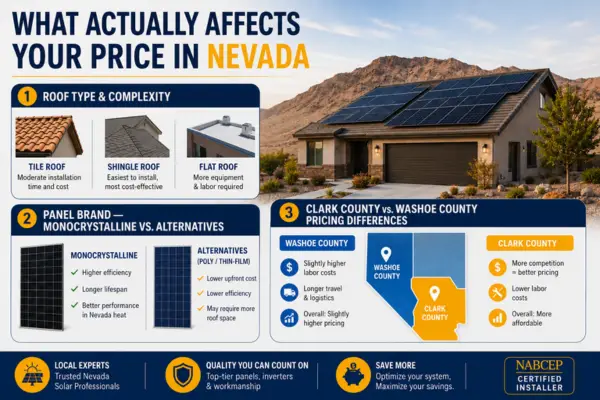
Two Nevada homes with identical system sizes can still land on very different quotes. The gap usually comes down to three things: your roof, your panel choice, and where in the state you live.
Roof Type & Complexity
A simple, south-facing asphalt roof is the cheapest to install fast work, minimal hardware. Tile roofs, steep pitches, and multi-level homes add mounting complexity and labor time, which shows up directly in your quote. Shading from trees or nearby structures adds another cost layer too, often requiring micro-inverters instead of a standard setup.
Panel Brand Monocrystalline vs. Alternatives
Monocrystalline panels dominate Nevada installs for a practical reason: they hold up better in extreme heat than polycrystalline or thin-film options, losing less efficiency once temperatures climb past 100°F. They cost more upfront, but in a state where triple-digit heat is routine for months at a time, that tradeoff usually pays for itself in real-world output.
| Panel Type | Efficiency | Heat Performance | Nevada Fit |
| Monocrystalline | 20–22% | Best Minimal output loss in extreme heat | Most common choice statewide |
| Polycrystalline | 15–17% | Noticeable efficiency drop above 100°F | Budget option, but weaker in summer |
| Thin-Film | 10–13% | Good heat tolerance, but lower overall output | Rare for residential roofs |
Clark County vs. Washoe County Sun & Cost Impact
Your county changes more than permitting speed, it changes how much sun your system actually gets. Las Vegas and Henderson average 6.0–6.5 peak sun hours daily, Reno and Sparks get only 5.0–5.3, about 15% less.
Upfront pricing barely shifts because of this, but system sizing does. Washoe County homes often need a slightly larger system to hit the same output as a comparable Clark County install. Worth confirming your quote already accounts for this before you sign.
Where Your Money Goes Equipment vs. Labor vs. Permits
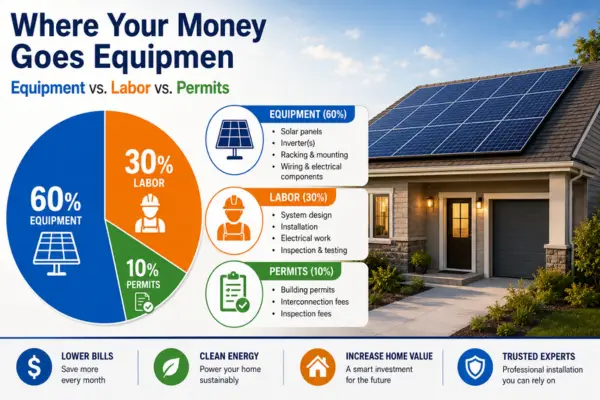
Every Nevada solar quote breaks down the same way, roughly. Here’s the split on a standard install:
| Cost Component | Approximate Cost | What It Includes |
| Equipment | Part of the $2.34/W installed price | Solar panels, inverter(s), racking, wiring, disconnects and monitoring equipment |
| Labor & Installation | Part of the $2.34/W installed price | Roof mounting, electrical work, installation, system setup and commissioning |
| Permits & Inspections | $200–$500 for a standard residential system | Building/electrical permits, plan review and inspections; fees vary by jurisdiction |
Equipment eats the biggest chunk, and that’s expected panels and inverters are the core hardware doing the actual work. Labor comes next, covering everything from roof mounting to electrical hookup. Permits and interconnection fees round out the total, small individually but easy to overlook when comparing quotes.
If a quote leans heavily toward one category without explanation, say, unusually high labor with cheap panels it’s worth asking why. The split above is your benchmark for what a fair, balanced quote looks like.
Quick takeaways:
- Equipment = 55% of your total cost
- Labor = 30%
- Permits & interconnection = 15%
- A quote wildly off this split deserves a follow-up question
How the 2026 Federal Tax Credit Change Affects Your Bottom Line

The federal solar tax credit changed in a big way this year. Homeowners buying with cash or a loan no longer get the 30% discount. It expired for systems installed after 2025. That means every number in this guide reflects your real, full cost, not a post-credit price.
Lease and Power Purchase Agreement (PPA) customers still benefit indirectly, since installers claim a separate commercial version of the credit and often pass some savings through a lower rate.
Quick takeaways
- 30% federal credit = gone for cash/loan purchases (expired after 2025)
- Lease/PPA customers still get indirect benefit through installer-passed savings
- All prices in this guide = real, full cost, no hidden discount assumed
Financing Impact on Total Cost
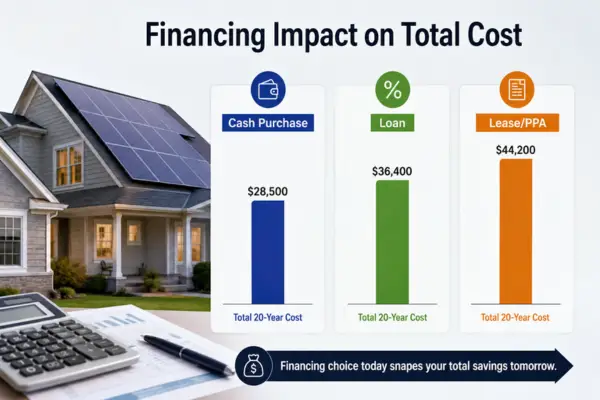
How you pay changes your real installation cost more than most homeowners expect. Cash buyers pay the least overall, loan buyers pay more due to interest, and lease or PPA customers pay the least upfront but never own the system.
Cash vs. Loan – Real Out-of-Pocket Numbers
Paying cash is straightforward, no interest, no monthly payment, just the upfront number from the cost table above. For a typical Nevada system, that’s roughly $13,000 to $20,000 out the door, and every dollar of savings after that goes straight to you.
A solar loan spreads that cost out, but it’s not free money. Nevada solar loans run 5–8% APR, and without the federal credit to shrink the loan principal, interest adds up faster than it used to.
A $20,000 system financed at 7% over 15 years can cost several thousand dollars more than the sticker price by the time it’s paid off. Loans still make sense if the alternative is not going solar at all just go in knowing the real, all-in number, not just the monthly payment.
Quick takeaways:
- Cash purchase = $13,000–$20,000 upfront, no interest, maximum long-term savings
- Solar loans run 5–8% APR in Nevada
- A $20,000 loan at 7% over 15 years can add several thousand dollars in total interest
Lease/PPA – Lower Cost, No Ownership
Land leases and PPAs flip the math entirely. Zero money down, no loan to qualify for, and someone else handles maintenance. The catch is ownership: you’re renting the system, not buying it, so you never build equity or claim the savings a purchased system delivers over 25 years.
This route makes the most sense if upfront cash isn’t an option, or if you don’t plan to stay in the home long enough for a purchase to pay off. Just know the tradeoff going in: lower cost now, smaller savings over time.
Quick takeaways:
- $0 down, no loan approval needed
- Installer/provider handles maintenance
- You never own the system or build equity
- Best fit for short-term homeowners or those without upfront cash
How to Get an Accurate Quote
A trustworthy Nevada solar quote should clearly separate:
- Panel and inverter cost: the equipment itself
- Labor: installation, wiring, and electrical work
- Permits: your local building permit fee
- Interconnection: the separate NV Energy application fee
If a quote lumps all of this into one flat number, ask for the breakdown. A legitimate installer can explain exactly what you’re paying for.
Frequently Asked Questions
What’s the average cost of solar panels in Nevada?
Nevada homeowners pay around $2.34 per watt in 2026, putting a typical system between $15,000 and $29,000 depending on size. That figure covers panels, inverter, racking, and labor permits and interconnection fees come separately.
How much does a 10kW system cost in Nevada?
A 10 KW system in Nevada runs roughly $23,000 to $27,000 before any additional fees. At this size, the per-watt price drops to around $2.40, cheaper than what smaller systems pay per watt.
Is solar cheaper in Nevada than other states?
Yes. Nevada ranks among the three most affordable states for solar installation, behind only Arizona and New Mexico. Intense desert sun and a competitive installer market in Las Vegas and Reno both help keep prices down.
Do permit and interconnection fees add to the total cost?
Yes, and they’re often left out of the headline price. Local building permits run $200 to $500, while the separate NV Energy interconnection application adds another $184 to $189. Always ask your installer whether these are included in your quote.
How can I lower my solar installation cost in Nevada?
Get at least three quotes and compare the itemized breakdown, not just the bottom line. Choosing a slightly larger system can lower your cost per watt, and paying cash instead of financing avoids interest charges entirely. If your roof is simple and shade-free, you’re already starting from the cheapest scenario.
Conclusion
Solar pricing in Nevada isn’t complicated once you know what to look for. A fair quote breaks down clearly, your system size shapes your per-watt rate, and your county quietly affects how hard that system has to work for you. Whether you pay cash, finance, or lease, the real cost is always in the details so ask for the breakdown, compare a few installers, and let the numbers do the deciding.