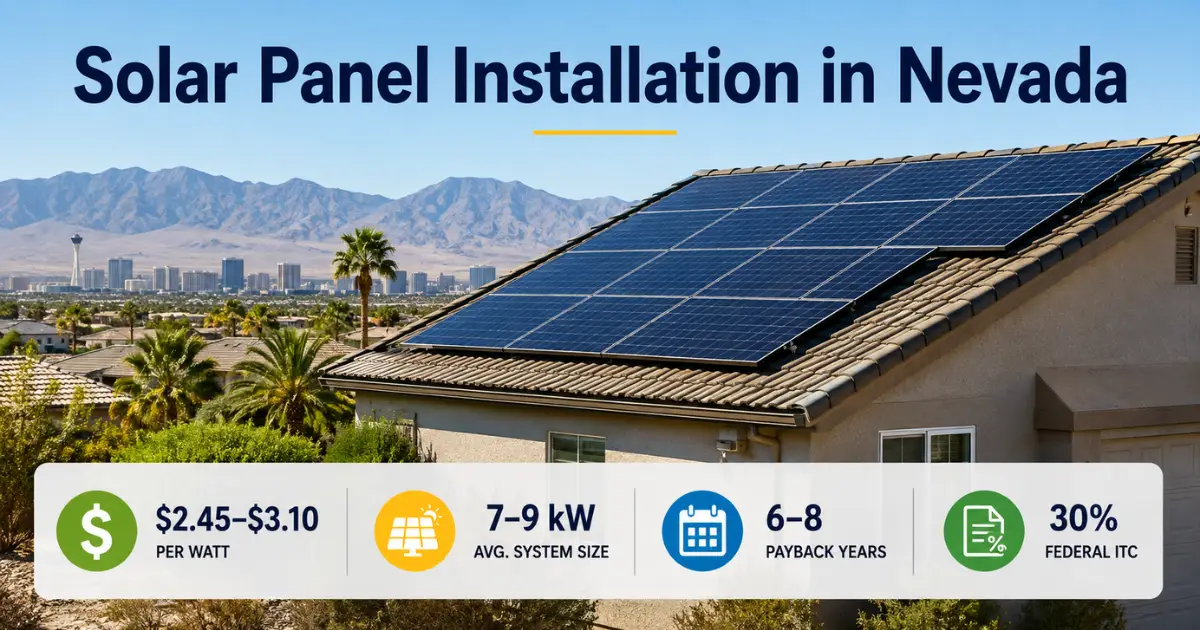
Solar panel installation in Nevada averages $2.34 per watt in 2026. This number matters more than it used to, because the federal tax credit that used to soften it no longer applies to systems you buy with cash or a loan. Most homeowners now pay $14,000 to $32,000 out of pocket depending on system size, with no 30% offset unless they go the lease or PPA route instead.
Nevada still ranks among the cheapest states to go solar, driven by intense desert sun. It is a competitive solar installer market in Las Vegas and Reno. This guide covers real 2026 installation costs, which incentives actually still apply, the full permitting and interconnection process, and how to vet a qualified installer, built around Nevada’s actual rules and utility structure, not outdated national averages.
Key Takeaways
- $2.34/watt – Nevada’s average installed solar cost, mid-2026
- 10–12.25 kW – system size for Nevada homes
- $23,400–$28,666 – average cost range before incentives
- $0 – federal tax credit for cash/loan purchases (expired January 1, 2026)
- 10–11 years – typical payback period without the federal credit
- 6.41 hours/day – Nevada’s peak sun exposure, among the highest in the US
How Much Does Solar Panel Installation Cost in Nevada?
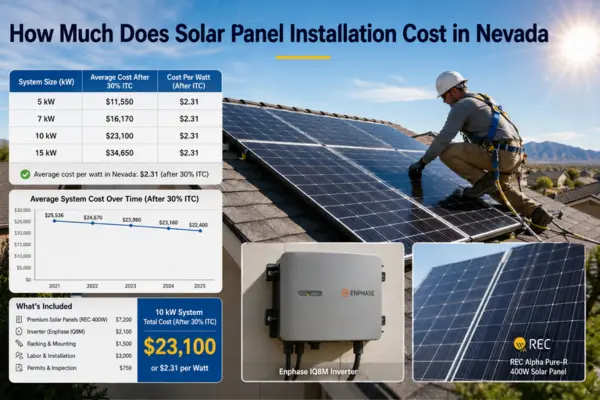
As of July 2026, the average solar system installation cost in Nevada is around $2.34 per watt with a 12.25 KW system before incentives. That’s noticeably below the national average of $2.85 per watt. Only Arizona and New Mexico beat Nevada on price among major solar states.
Why does Nevada run cheaper? Las Vegas has a competitive installer market that pushes prices down. While rural Nevada sees higher quotes due to fewer local providers. Monocrystalline solar panels dominate here since they hold up better against desert heat than polycrystalline or thin-film alternatives a Nevada-specific factor most national guides skip.
| Solar System Size | Estimated Cost (Before Incentives) |
| 6 kW | $14,040 |
| 8 kW | $18,720 |
| 10 kW | $23,400 |
| 12.25 kW (NV Average) | $28,666 |
Prices calculated at Nevada’s 2026 average rate of $2.34/watt and reflect cash-purchase cost before any incentives. The federal tax credit no longer applies to cash or loan purchases in 2026 (see Incentives section below). Actual quotes shift with roof type, panel brand, and installer overhead. Full pricing breakdown [Nevada Solar Cost Breakdown 2026].
Nevada Solar Incentives & Rebates (2026)
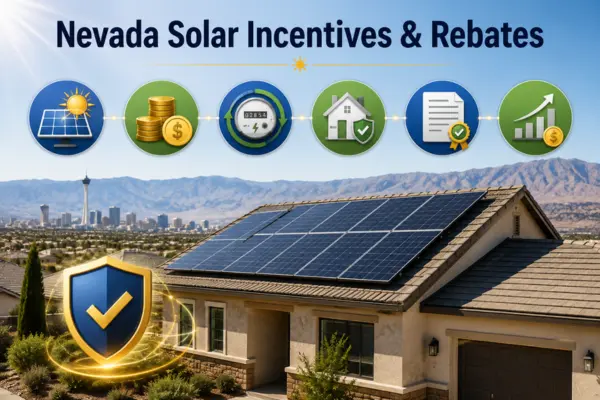
The incentive landscape for Nevada solar changed more in the past year than in the previous decade combined. Some programs that homeowners relied on for years are gone, others are quietly still working in the background here’s exactly what still applies in 2026, and what doesn’t.
Federal Tax Credit: What Changed for 2026
by the One Big Beautiful Bill Act, the residential solar tax credit under Section 25D expired for customer-owned systems installed after 2025. No phase-down, no grandfather period. The credit went from 30% to zero on January 1, 2026.
Third-party-owned systems leases and PPAs still qualify. This is because the solar system installer claims the commercial version of the credit (Section 48E) and passes some savings through a lower monthly rate. If your system was placed in service before the end of 2025, the 30% credit still applies on that year’s return.
Example: A Henderson homeowner buying an 8 KW system with cash in 2026 pays full price no federal offset. The same homeowner signing a 20-year Power Purchase Agreement (PPA) instead effectively taps into that commercial credit through the rate they’re quoted. Even though it never shows up on their own tax return.
NV Energy Net Metering: How the Buyback Rate Actually Works
Nevada’s net metering isn’t flat, it’s tiered, and it’s been stepping down since 2017. Nevada is currently in Tier 4. It pays solar customers 75% of the retail rate for excess power sent to the grid, down from the 95% rate early adopters locked in years ago.
Excess daytime production earns bill credits at that 75% rate. It is applied automatically the next time you draw more power than you generate. That matters in Nevada specifically because AC load peaks in the evening, after solar production has already dropped off.
Nevada’s baseline electricity rates run about 22% below the U.S. average. And roughly 60% below California’s. A lower buyback tier still compares well against states with worse net metering but higher retail rates.
Property Tax, Sales Tax & Local Rebates
Nevada does not exempt residential solar from property tax. Only commercial projects qualify for that abatement. Nevada charges its standard 6.85%+ rate on equipment.
The one concrete rebate available: NV Energy and SW Gas offer $1,800–$3,500 for solar water heating systems not standard PV panels, but worth bundling in if you’re already re-doing your water heater.
| Incentive | Available in 2026? | Value |
| Federal ITC (cash/loan) | ❌ Expired | $0 |
| Federal ITC (lease/PPA) | ✅ Indirect | Passed through rate |
| NV Energy net metering | ✅ Tier 4 | 75% of retail rate |
| Property tax exemption | ❌ Residential: No | N/A |
| Sales tax exemption | ❌ No | N/A |
| Solar water heating rebate | ✅ Yes | $1,800–$3,500 |
Is Solar Worth It in Nevada?
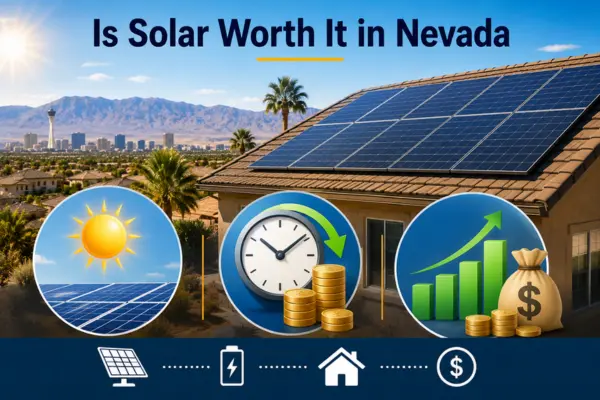
Nevada answers this question better than most states. It is not because incentives are generous (they aren’t anymore), but because the sun simply does more of the heavy lifting almost anywhere else in the country (USA).
Peak Sun Hours & Payback Period
Nevada’s average sun hour is around 6.41 hours per day. It is the highest in the country (United States), behind only Arizona and New Mexico. A 10 KW system produces roughly 17,000–19,000 kWh. It covers most Nevada households through the peak summer AC season.
The number that changed with the ITC: a $23,400 gross 10 kW system (at $2.34/W) now pays back in 10 to 11 years through electricity savings alone up from the 7–8 years. It took with the old 30% credit. Nevada’s low solar panel install costs and strong sun still keep that window tighter than most states manage even without federal help.
25-Year Savings Estimation
A 10 KW system producing 17,500 KWh annually. Offsetting, Nevada’s below-average electricity rate, saves a household $2,000–$2,400 a year. At today’s prices before factoring in the 2–3% annual rate increases utilities have historically posted.
Compounded over 25 years: $55,000–$75,000+ in lifetime savings, depending on rate movement and how much of your usage the system offsets.
Estimates based on current NV Energy rates and 2026 federal tax policy. Consult a licensed tax professional and get a site-specific quote before deciding.
Step-by-Step Solar Installation Process in Nevada (USA)
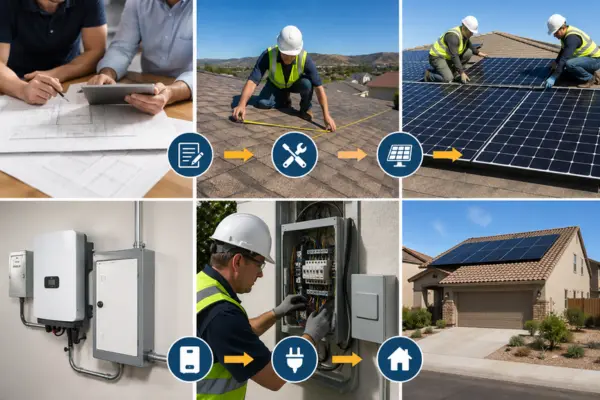
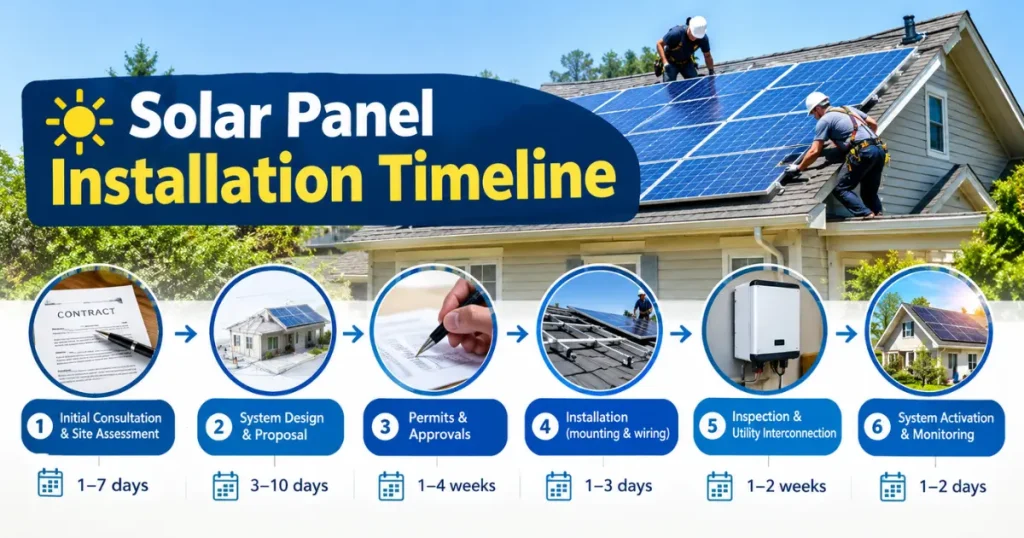
Most homeowners picture solar as: sign a contract, panels go up, done. In Nevada, that’s roughly the halfway point. What actually gets your system live is a three-way handoff between your installer, the local building department, and NV Energy, and skipping or mis-ordering any one step is how a “two-week install” quietly turns into a four-month wait. Here’s the real sequence, start to grid connection.
Assessment, Permitting & Design
An installer visits your home to check roof condition, shading, and electrical panel capacity, then designs a system and files two applications: local building permit and NV Energy interconnection.
Permit fees run $200–$500, approved in 1–3 weeks. Clark County offers same-day online permitting; North Las Vegas takes 2–4 weeks; Washoe County adds fire code setbacks Clark doesn’t enforce. File both applications in parallel waiting for the permit before starting the NV Energy application adds unnecessary weeks.
| Step | Timeline | Cost |
| Site assessment & design | 1–3 days | Included in quote |
| Local building permit | 1–3 weeks | $200–$500 |
| NV Energy interconnection application | Parallel with permit | $184–$189 |
Installation Day & NV Energy Interconnection
Physical installation takes 1–3 days. The system can’t legally turn on yet NV Energy still has to review the interconnection application through PowerClerk, in stages capped at 10 business days each. Most residential systems qualify for fast-track review. NV Energy installs your bidirectional net meter free for systems 25 kW or smaller.
One detail most guides miss: Northern Nevada now measures exports in 15-minute intervals under NMR-2025, while Southern Nevada stays on the older NMR-405 Tier 4 structure Reno and Las Vegas systems earn credits differently.
Inspection & Permission to Operate (PTO)
A local inspector checks mounting, wiring, and grounding separate from NV Energy’s own final inspection. PTO typically follows within 2–6 weeks of that check.
Total timeline: 2–6 months from first site visit to full operation. A simple Clark County install can land in 6–8 weeks; a Washoe County project needing a panel upgrade or HOA review can stretch past four months, not a delay, just more steps in sequence.
Nevada Solar Permits & HOA Rules
Nevada law protects your right to go solar, even inside an HOA community, but there are rules on both sides worth knowing.
Your rights under Nevada law (NRS 278.0208)
- No HOA rule, deed covenant, or contract clause can prohibit or unreasonably restrict solar installation
- HOAs can require reasonable placement or aesthetic guidelines — but not if they cut system efficiency by more than 10% without offering a comparable, similarly-priced alternative
- Black solar glazing bans are specifically prohibited
HOA response deadlines (Senate Bill 440, effective October 1, 2025):
- 15 days to respond if the HOA has no existing solar policy
- 35 days if a solar policy already exists
- No more sitting on an application until the next board meeting
- Missed deadline or unreasonable denial → file with the Nevada Real Estate Division’s Common Interest Community Ombudsman
Permitting jurisdiction varies by location:
- Unincorporated Clark County → county building department
- Las Vegas city limits → City of Las Vegas Building Department (same-day online permitting for licensed contractors)
- Reno / Washoe County → separate process, additional fire code setbacks
| Rule | What It Means |
| NRS 278.0208 | HOAs cannot ban solar; only reasonable placement rules allowed |
| SB 440 (effective Oct 2025) | HOA must respond in 15 to 35 days |
| Efficiency protection | HOA rules can’t cut output more than 10% without a comparable fix |
| Dispute resolution | File with the Common Interest Community Ombudsman |
Choosing a Solar Installer in Nevada
Not every licensed contractor in Nevada delivers the same quality of work, and the difference often shows up years later in a leaking roof penetration, an underperforming system, or a warranty claim nobody honors. Two credentials separate a solid installer from a risky one, and knowing what each actually means before you sign protects you more than any sales pitch will.
NABCEP & NSCB License Verification
Two separate credentials matter here, and they’re not interchangeable.
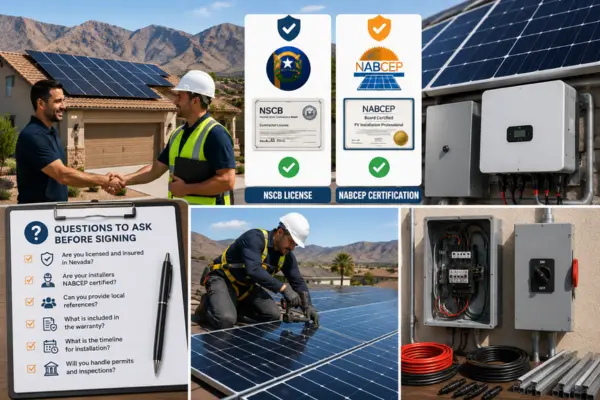
NSCB license (mandatory)
Every solar contractor working in Nevada must hold a C-2g Photovoltaic license issued by the Nevada State Contractors Board. This isn’t optional, it’s the legal license that lets a solar installation company pull permits and legally connect a system to the grid.
Before signing anything, look up the contractor’s license number directly on the NSCB’s public database and confirm it’s active and specifically covers C-2g, not just a general electrical license.
NABCEP certification (recommended, not required)
NABCEP is the industry’s leading professional certification for solar installers, and Nevada’s own licensing exam draws its technical standards from NABCEP and IREC guidelines.
It’s not legally required to install solar in Nevada, but a NABCEP-certified installer has passed a rigorous, nationally recognized exam beyond the state minimum, a solid signal of technical depth, especially for a complex roof or a battery-integrated system.
What license verification does not tell you: an active license confirms legal standing, not workmanship quality or current insurance/workers’ comp status. Ask for proof of both separately.
Questions to Ask Before Signing
- Can you show me your NSCB C-2g license number, and will you confirm it’s active while I’m on the call?
- Are any of your installers NABCEP-certified, and will one be on-site during my installation?
- Who files my NV Energy interconnection application, and does it go in parallel with the building permit?
- What’s your typical timeline from contract signing to Permission to Operate, based on my county?
- What happens if my HOA doesn’t respond within the 15–35 day window required under SB 440?
- Is my equipment and labor covered by a workmanship warranty, and for how many years, separate from the manufacturer’s panel warranty?
- What’s the total price per watt, and does that include permit fees and the NV Energy interconnection fee, or are those extra?
Nevada Solar Financing Options: Cash, Loan, Lease & PPA Compared
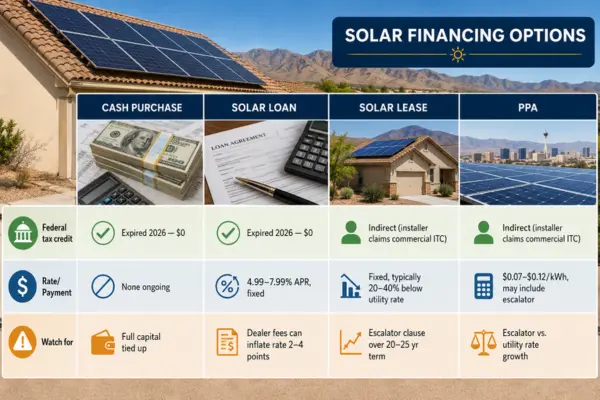
How you pay for solar in Nevada matters more in 2026 than it did a year ago, now that the federal tax credit no longer applies to systems you buy outright. Each option shifts ownership, savings, and risk differently.
| Comparison | Cash Purchase | Solar Loan | Solar Lease | PPA |
| Federal Tax Credit | Expired 2026 — $0 | Expired 2026 — $0 | Indirect — installer claims commercial ITC | Indirect — installer claims commercial ITC |
| Rate / Payment | No ongoing payment | 4.99–7.99% APR, fixed | Fixed, typically 20–40% below utility rate | $0.07–$0.12/kWh, may include escalator |
| Watch For | Full capital tied up | Dealer fees can inflate rate 2–4 points | Escalator clause over 20–25 yr term | Escalator vs. utility rate growth |
Well-qualified borrowers can find solar-specific loans as low as 4.99–6.99% APR, while home equity loans run 6.5–8.5% and personal loans 7–15%. Without the ITC offsetting the loan principal, a high-APR loan can produce weaker long-term value than a straightforward lease
Frequently Asked Questions
How much do solar panels cost in Nevada in 2026?
Nevada solar averages $2.34 per watt installed, putting a typical 10 kW system at around $23,400 before incentives. With the federal tax credit no longer available for cash or loan purchases, that’s now the real out-of-pocket cost unless you go with a lease or PPA.
Does Nevada still have net metering?
Yes, NV Energy pays 75% of the retail rate for excess solar sent back to the grid under Tier 4, down from the 95% early adopters received. Still worthwhile for most homeowners.
How long does installation take?
Two to six months from first site visit to full operation, including permitting, installation, and NV Energy’s interconnection approval. A straightforward Clark County project can finish in six to eight weeks.
Do I need a permit to install solar panels in Nevada?
Yes, a local building permit plus a separate NV Energy interconnection application. Permit fees run $200 to $500, and your contractor must hold an active NSCB C-2g license to file either.
Is solar worth it in Las Vegas?
Yes, high sun exposure and below-average electricity rates keep costs competitive even without the federal credit. Most homeowners recoup their investment in 10 to 11 years.
Conclusion
Solar in Nevada in 2026 works differently than it did a year ago with no federal credit for cash or loan buyers, net metering pays less, and there’s no residential property tax break. That doesn’t make it a bad decision. It means running the numbers with today’s rules, not the outdated “30% off” pitch most people still expect.
A 10 kW system still pays for itself within a decade on Nevada’s sun and below-average electricity rates. Pick the financing structure that matches how much ownership and upfront cost you’re comfortable with, and the math still works.