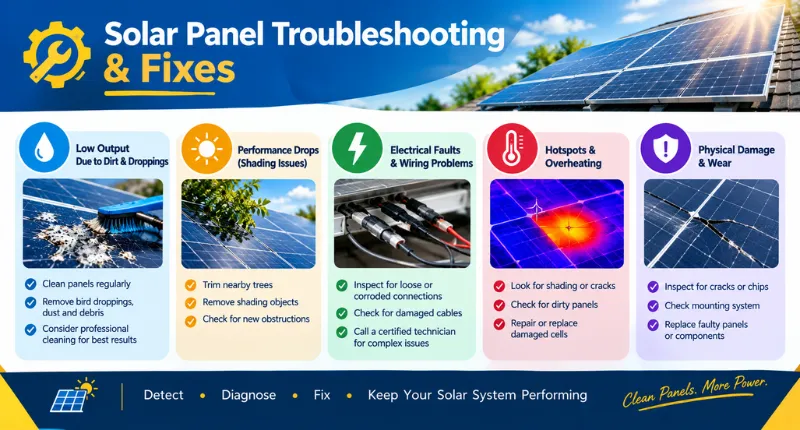
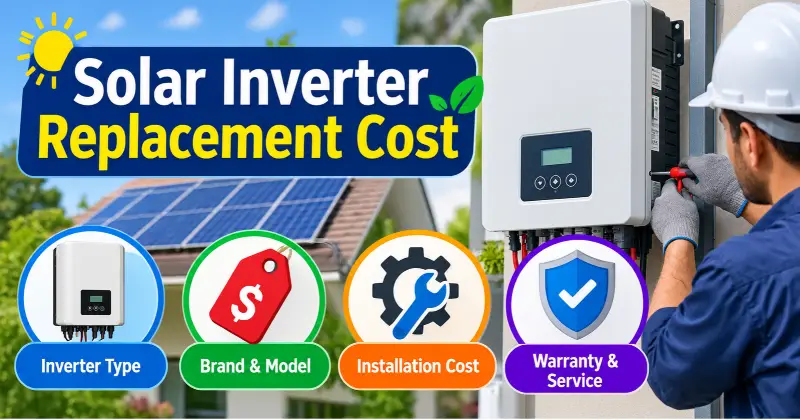
Replacing a residential solar inverter in the United States in 2026 costs between $1,500 and $3,500 on average. For high-capacity hybrid systems paired with battery storage or extensive multi-panel microinverter arrays, total replacement expenses can range from $2,600 to $5,500. These figures reflect verified 2026 market data, combining the wholesale equipment purchase price with certified solar technician installation labor.
Before paying out of pocket, check your original installation contract. Standard central string inverters carry a 10 to 12-year warranty, while premium microinverters are backed by a 25-year manufacturer warranty. If your hardware is still covered, the manufacturer will ship a replacement unit completely free, leaving you responsible only for local diagnostic and labor fees.
The table below outlines real-world financial projections for different solar inverter technologies and service tiers across the US market:
| Inverter Technology / Job Type | Average Equipment Cost | Average Labor Cost | Total Estimated Cost |
| Diagnostic Visit Only | N/A | $150 – $300 | $150 – $300 |
| Minor Repair (Fuse, Fan, Capacitor) | $50 – $250 | $200 – $400 | $250 – $650 |
| Central String Inverter (Standard) | $1,200 – $2,500 | $300 – $600 | $1,500 – $3,100 |
| Single Microinverter (Roof Swap) | $150 – $300 | $250 – $500 | $400 – $800 |
| Hybrid Inverter (Battery-Ready) | $2,500 – $4,500 | $500 – $1,000 | $3,000 – $5,500 |
How Much Does a Solar Technician Inspection Cost?
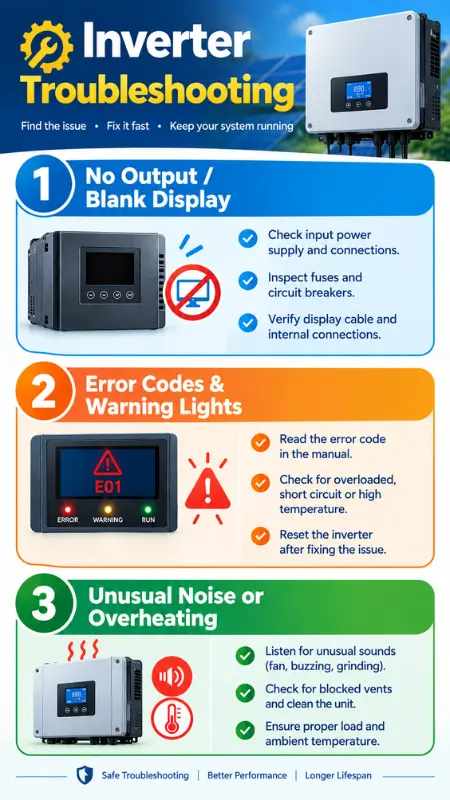
A professional solar technician inspection costs between $150 and $300 across most US states. This straightforward baseline fee-commonly referred to by contractors as a service call fee. It covers the certified solar electrician’s travel time, initial system troubleshooting, digital error code extraction, and structural safety checks using a calibrated multimeter.
Paying for this initial diagnostic visit prevents you from wasting thousands of dollars on a complete inverter replacement when your system might only have a minor, easily fixable internal issue like a blown fuse or a loose wire connection.
The standard financial breakdown for an on-site residential solar inspection follows this structure:
- Standard Service Fee: $150 – $300 (covers the technician’s travel, tool deployment, and the first hour of deep diagnostic system testing).
- Emergency Dispatch Fee: $300 – $450 (applied when urgent troubleshooting is requested outside of standard operational business hours or during holidays).
- The Service Fee Credit: Most highly rated local US solar contractors will entirely credit this 150–300 inspection charges toward your final repair or replacement bill if you hire their team to execute the physical repair work.
Repair Cost by Issue (fuse, fan, capacitor, connector, firmware)
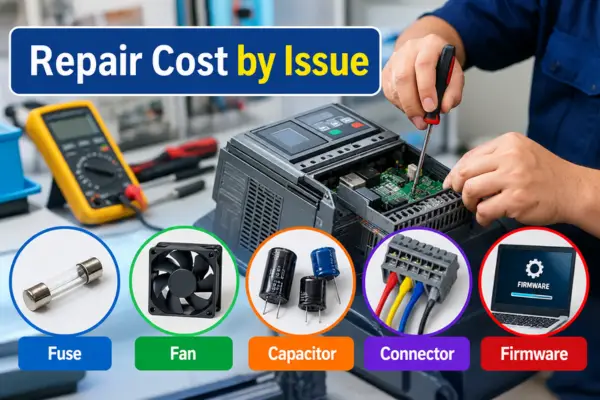
Repairing a solar inverter instead of replacing it costs between $150 and $650, depending on which internal component has failed. Modern residential string and hybrid units consist of modular circuit sections that can often be serviced individually. Fixing these specific issues restores your clean energy production at a fraction of the cost of a full system swap.
The data table below outlines the realistic expenses for fixing the five most common inverter hardware and software failures across the US market:
| Inverter Failure Mode | Average Part Cost | Average Labor Cost | Total Repair Cost |
| Blown DC/AC Fuse | $10 – $50 | $150 – $300 | $160 – $350 |
| Broken Cooling Fan | $30 – $100 | $200 – $350 | $230 – $450 |
| Degraded Circuit Capacitor | $20 – $80 | $250 – $500 | $270 – $580 |
| Corroded MC4 Connectors | $15 – $40 | $200 – $350 | $215 – $390 |
| Firmware Glitch / Code Reset | N/A | $150 – $300 | $150 – $300 |
Blown DC/AC Fuse
Inverters utilize heavy-duty internal fuses to protect delicate silicon microchips from sudden utility grid surges or lightning strikes. Replacing this component is a straightforward ground-level job that takes under an hour, resulting in minimal labor fees.
Broken Cooling Fan
Centralized string units generate massive thermal energy while converting raw DC currents into usable household AC power. If the internal cooling fan wears out or jams with dust, the system will immediately throw a high-temperature warning code and halt production to prevent melting.
Degraded Circuit Capacitor
Internal capacitors act as tiny power reservoirs that smooth out erratic electrical currents before sending them to your home appliances. Because these components are constantly exposed to high voltages, they degrade over time and can eventually bulge or leak chemical electrolytes. Soldering a fresh capacitor onto the main circuit motherboard requires precision technical expertise, making this the most expensive repair job on the list.
Corroded MC4 Connectors
External roof wiring links individual solar panels together using specialized heavy-duty MC4 plastic plugs. Constant exposure to intense solar radiation, heavy rain, or shifting snow can dry out these plastic seals, allowing moisture to slip inside and rust the copper terminals. A technician must track down the specific point of failure on the roof, cut away the ruined copper wires, and crimp on brand-new, weatherproof connectors.
Firmware Glitch / Code Reset
Sometimes, an inverter shuts down completely even though every single physical part inside is perfectly healthy. This issue usually stems from a corrupted automated software update or a communication error with your home Wi-Fi network. Fixing this requires a solar technician to plug a diagnostic laptop directly into the system’s motherboard, clear the active system faults, and force-install the latest stable manufacturer firmware patch.
Full Replacement Cost for Microinverters (per unit)
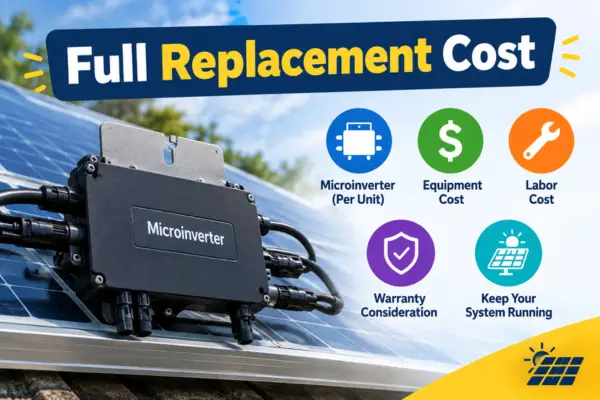
Replacing a single, out-of-warranty roof-mounted microinverter costs between $400 and $800 all-in. If you choose to replace an entire failing batch or complete a full 20-panel system swap, the total cost scales to between $3,000 and $6,000. While buying an individual microinverter unit is highly affordable, the physical labor involved drives up the final service invoice.
Unlike ground-level string systems, replacing microinverters requires technicians to scale the roof and locate the specific malfunctioning node. The certified electrician must carefully unbolt the solar module racking, disconnect the plug-and-play Enphase IQ8 Microinverter unit, integrate the new hardware, and complete localized weatherproofing.
The table below breaks down the pricing for single-unit swaps versus complete residential arrays based on current market rates:
| Replacement Scope | Hardware Cost (Per Unit) | Average Labor Cost | Total Project Price |
| Single Unit Swap | $150 – $350 | $250 – $450 | $400 – $800 |
| 5 kW Array Swap (approx. 12 units) | $1,800 – $3,600 | $1,000 – $1,800 | $2,800 – $5,400 |
| 10 kW Array Swap (approx. 24 units) | $3,600 – $7,200 | $1,800 – $3,200 | $5,400 – $10,400 |
- Modular Advantage: If one unit fails, the remaining array generates electricity completely uninterrupted.
- Warranty Cushion: Premium microinverters feature standard 25-year manufacturer coverage, making out-of-pocket hardware fees for premature failures very rare.
Full Replacement Cost for Hybrid Inverter (with battery)
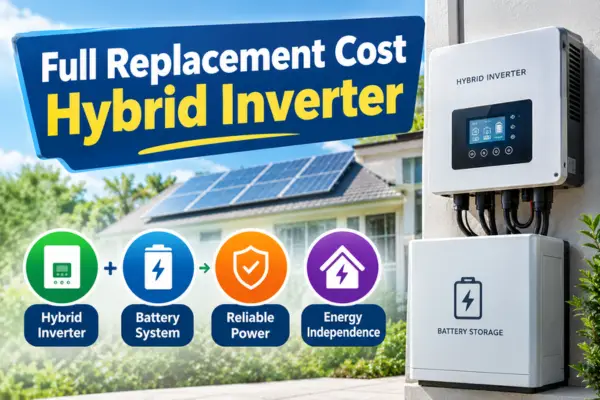
A full residential hybrid inverter replacement costs between $3,000 and $6,000 including professional installation. This price covers the centralized battery-ready conversion unit itself; the actual storage batteries are sold and priced separately. Because hybrid models contain advanced dual-direction power management circuitry, they command a steep premium over standard string units.
Hybrid setups process high-voltage DC electricity directly from the solar panels and route it straight into a home battery storage bank with minimal conversion losses. When a hybrid system fails, your entire home solar grid and emergency backup architecture stall.
Swapping out this gear requires advanced electrical programming to match the unit’s software to your specific home battery chemistry and regional grid profile. The table below profiles the financial layout required to swap common hybrid inverter configurations:
| System Output Capacity | Hardware Unit Price | Advanced Labor & Permit | Total Replacement Cost |
| 5 kW Hybrid System | $1,500 – $2,500 | $600 – $1,000 | $2,100 – $3,500 |
| 8 kW Hybrid System | $2,200 – $3,800 | $800 – $1,400 | $3,000 – $5,200 |
| 12 kW Hybrid System | $3,500 – $5,000 | $1,000 – $1,800 | $4,500 – $6,800 |
- Complex Configurations: The internal software manages grid connection, domestic usage, and charge cycles simultaneously.
- Hidden Fees: Replacing old hybrid gear frequently requires purchasing updated conduit boxes, system controllers, or local municipal fire safety permits.
Cost by Brand (Enphase, SolarEdge, SMA, Tesla, Fronius, Growatt)
Brand selection dictates up to 60% of your total equipment invoice, with average residential solar inverter costs ranging from $1,100 for budget options to $5,200 for premium modular configurations. Different manufacturers utilize distinct engineering architectures, structural software ecosystems, and proprietary hardware features that directly impact wholesale distribution pricing.
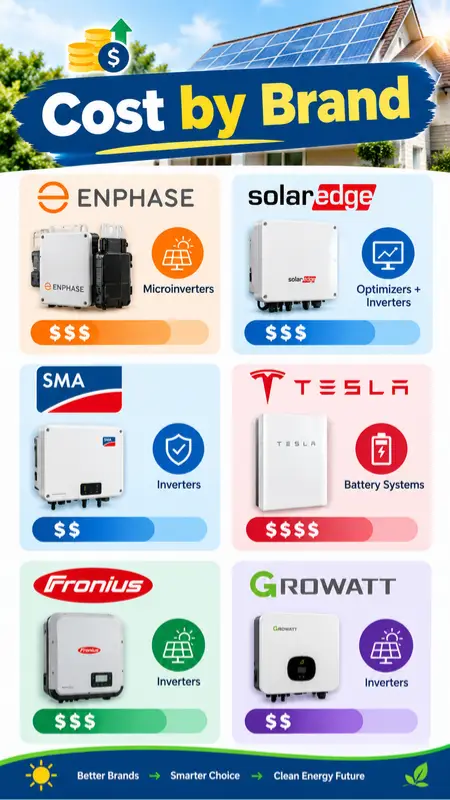
The data table below outlines standard equipment purchase prices and total calculated replacement costs across the six leading residential solar brands in the US market:
| Brand Name | Primary Inverter Type | Equipment Unit Price | Total Replacement Cost (Parts + Labor) |
| Enphase Energy | Modular Microinverter Array | $150 – $350 (Per Node) | $2,600 – $5,200 (Full System) |
| SolarEdge | Optimized Central String | $1,200 – $2,600 | $1,900 – $3,800 |
| Tesla (Solar Inverter) | Hybrid Battery-Ready | $2,000 – $3,400 | $2,800 – $4,900 |
| SMA Energy (Sunny Boy) | Centralized String | $1,300 – $2,400 | $1,600 – $3,200 |
| Fronius | Premium String / Hybrid | $1,500 – $2,800 | $2,100 – $3,900 |
| Growatt | Budget Central / Hybrid | $800 – $1,800 | $1,300 – $2,600 |
Enphase Energy: Utilizes independent microinverters mounted under each panel. While single-unit hardware is cheap, replacing a full array requires high hardware volume and extensive roof labor.
SolarEdge: Combines a central string unit with individual panel power optimizers. If the central brain dies, replacing it requires mid-tier pricing while preserving existing roof optimizers.
Tesla: Specializes in high-efficiency hybrid inverters designed to sync natively with Powerwall storage backups, commanding a premium price for integrated software control.
SMA & Fronius: Offer rugged, industrial-grade central string units with active internal cooling properties that deliver long operational lifespans for standard grid-tied properties.
Growatt: Serves as the leading value-focused alternative, providing highly competitive entry-level pricing for both grid-tied setups and off-grid battery integrations.
Labor Cost & Regional Price Differences
Certified solar electrician labor accounts for $300 to $1,800 of your final replacement invoice, driven by regional licensing laws and the physical complexity of the installation site. Local solar contractors charge between $75 and $175 per hour depending on state-level overhead costs, corporate insurance requirements, and local cost-of-living indexes.
The table below breaks down regional labor averages, typical project duration, and total installation labor expenses across the United States:
| Geographic US Region | Average Hourly Rate | Average Repair Labor (1–2 Hours) | Full Replacement Labor (3–6 Hours) |
| Northeast (NY, NJ, MA, CT) | $120 – $175 / hr | $240 – $350 | $600 – $1,400 |
| West Coast (CA, WA, OR, AZ) | $110 – $165 / hr | $220 – $330 | $550 – $1,200 |
| Southeast (FL, GA, NC, SC) | $75 – $110 / hr | $150 – $220 | $300 – $800 |
| Midwest / South (TX, OH, IL, MI) | $80 – $115 / hr | $160 – $230 | $350 – $900 |
Licensing Constraints: States in the Northeast and West Coast require specialized unlimited electrical licenses and dedicated solar certifications, which inflates local contractor hourly rates.
Physical Hazards: Roof-mounted microinverters cost significantly more in labor because technicians must set up fall-protection staging, scale the roof, and manually lift solar modules to access defective components.
Permitting Fees: Certain high-density municipalities charge an additional $100 to $300 for structural electrical permits or utility net-metering re-inspection sign-offs before a replacement system can legally go live.
What Warranty Covers and What It Doesn’t
Standard solar inverter warranties cover 100% of the replacement hardware costs for factory defects, but they almost never cover the physical labor charges required to swap the equipment. Residential string inverters carry an initial 10-to-12-year factory warranty, while premium microinverters natively feature extended 25-year manufacturer coverage.
Understanding these corporate contract limitations prevents unexpected out-of-pocket expenses when dealing with a premature equipment failure.
The table below breaks down exactly what standard tier-1 solar inverter manufacturer warranties cover versus what falls on the homeowner:
| Covered Under Factory Warranty | NOT Covered Under Factory Warranty |
| Internal circuit motherboard burnouts | Solar technician diagnostic visit fees (150–300) |
| Factory software firmware bricking | On-site equipment removal and installation labor |
| Pre-assembled hardware defect casing cracks | Shipping/freight costs for heavy replacement units |
| Premature failure of built-in cooling fans | Damage from lightning grid surges or severe weather |
| Defective factory liquid crystal displays (LCD) | Rodent infestation wire chewing or nesting damage |
Labor Protective Add-ons: Some premium installation companies provide an independent 5-to-10-year workmanship warranty that handles the labor fees missing from standard manufacturer hardware policies.
Void Warning Conditions: Hiring an uncertified, non-NABCEP technician to open the inverter housing or attempt a DIY soldering repair instantly cancels all remaining years of your factory warranty coverage.
Repair vs Replace – When Each Makes Financial Sense
Choosing to repair a solar inverter makes financial sense if the unit is under 8 years old and the fix costs less than $500, whereas a complete unit replacement is best if the hardware is past its 10-year lifespan. Evaluating the age of your system against the specific failure point prevents you from wasting money on patch fixes that might fail a few months later.
A brand-new unit comes with a refreshed 10-to-25-year manufacturer warranty, securing your long-term clean energy return on investment.
The decision matrix below outlines when you should approve a localized repair versus when you should invest in a full equipment replacement:
| Scenario Variables | Choose Localized Repair | Choose Full System Replacement |
| Equipment Age | System is 1 to 7 years old | System is 10 to 15+ years old |
| Component Failure | Broken cooling fan, blown fuse, or loose wire | Fried central mainboard or shorted transformer |
| Warranty Status | Hardware is fully covered by active policy | Factory warranty timeline has entirely expired |
| Project Financials | Repair quote is under 30% of replacement cost | Repair quote exceeds 50% of a brand-new unit |
| System Future | Preserves existing functional components | Restarts your system warranty timeline from zero |
How to Get a Fair Quote (multiple bids tip)
The most reliable way to secure a fair inverter replacement quote is to collect at least three independent bids from different local, licensed solar contractors. Gathering multiple offers forces regional companies to compete on price while highlighting any unnecessary markup padding on equipment or labor hours. A transparent technician will provide a detailed line-item estimate that separates the wholesale distribution cost of the inverter from the hourly field labor charges.
- Verify Credentials Direct: Ensure every bidding contractor holds a current certification from the North American Board of Certified Energy Practitioners (NABCEP) and carries active liability insurance.
- Demand Exact Hardware Matches: Make sure all three contractors are bidding on the exact same tier-1 hardware model and capacity to ensure an accurate, apples-to-apples price comparison.
- Negotiate Diagnostic Credits: Always ask if the company will deduct their initial diagnostic trip fee from the final installation balance if you sign the project contract with them.
Frequently Asked Questions
How much does it cost to replace a solar inverter?
The average cost to replace a residential solar inverter in the United States ranges from $1,500 to $3,500. This comprehensive estimate covers standard ground-level central string systems, while specialized hybrid setups or complete multi-panel microinverter swaps routinely scale between $2,600 and $6,000. Final project pricing depends heavily on the replacement hardware capacity, system configuration, and local electrician installation rates.
Is it cheaper to repair or replace a solar inverter?
It is significantly cheaper to repair basic component failures like cooling fans or blown fuses, which average $230 to $450, rather than purchasing a new unit. However, if a central system motherboard fries outside of its warranty window, full replacement becomes more cost-effective. Investing in a brand-new unit eliminates recurring repair fees and provides you with a fresh 10-to-25-year factory warranty.
How much does a solar inverter diagnostic visit cost?
A professional solar inverter diagnostic visit costs between $150 and $300 depending on your geographic location. This foundational service fee handles the technician’s travel time, digital fault code extraction, manual voltage tracking, and physical safety inverter connection checks. Most highly rated solar service providers will credit this inspection fee toward your final repair bill if you hire them for the follow-up work.
Do solar inverter warranties cover replacement cost?
Active factory warranties cover 100% of the replacement hardware equipment costs, but they almost never cover the physical installation labor charges. Standard manufacturer policies ship a brand-new inverter unit directly to your home free of charge if a defect occurs within the coverage window. The homeowner remains responsible for paying the local solar contractor’s diagnostic fees and hourly labor overhead.
How much does it cost to replace a single microinverter?
Replacing an individual out-of-warranty roof microinverter costs between $400 and $800 all-in. While purchasing a single microinverter unit is highly economical, matching current market distribution pricing at $150 to $350, the hazardous roof installation hikes labor fees. Technicians must deploy fall-protection equipment, climb onto the roof, unbolt the specific solar panel module, swap the nodes, and rebuild the waterproofing seals.
Is a hybrid inverter more expensive to replace than a string inverter?
Yes, a hybrid inverter costs $3,000 to $6,000 to replace, making it substantially more expensive than a standard string inverter which runs $1,500 to $3,100. Hybrid models integrate specialized dual-direction computerized processors that manage solar generation, domestic household power loads, and battery storage banks simultaneously. This complex computational infrastructure combined with advanced safety transfer switches commands a steep wholesale equipment premium.
How long does a solar inverter last before it needs replacing?
Traditional centralized string inverters feature an operational lifespan of 10 to 15 years before internal components wear out. Conversely, premium individual microinverters display superior structural resilience and routinely last 20 to 25 years under standard residential conditions. Because tier-1 solar panels easily produce electricity for 25 to 30 years, you should budget for at least one central inverter swap during your system’s lifetime.
Does labor cost more for roof-mounted vs ground-mounted inverters?
Yes, installation labor costs up to 50% more for roof-mounted equipment due to increased technician setup times and strict physical field safety rules. Ground-mounted centralized string units allow electricians to complete work safely at chest height using basic tools. Roof installations require workers to scale high roof slopes, deploy heavy-duty fall-safety harnesses, and manually manipulate glass solar modules to access underlying system wires.
Conclusion
Navigating a sudden solar inverter failure requires balancing initial diagnostic outlays against long-term operational electric bill savings. While an out-of-pocket hardware breakdown presents an unexpected maintenance bill, checking your active factory warranty coverage first can eliminate equipment costs completely.
Always gather at least three line-item competitive estimates from certified NABCEP solar technicians to avoid local market markup padding. Selecting the right repair path ensures your home solar infrastructure continues to shield you from rising public utility grid rates for the next decade.