
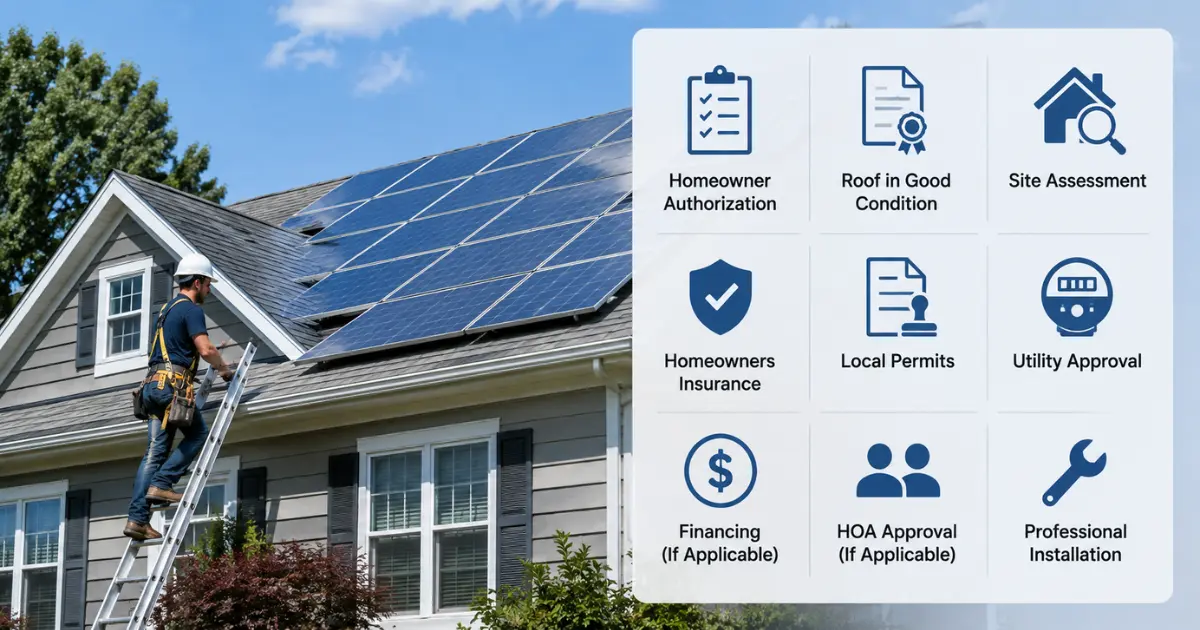
Before a single panel goes on your roof, several conditions have to line up and most homeowners find out about them only after signing a contract. Rooftop solar panel installation depends on roof condition and orientation, electrical capacity, local permitting rules, and your utility’s interconnection process. Skip any of these checks, and a straightforward project can turn into unexpected delays or added costs.
This guide breaks down exactly what installers assess before work begins, what documentation your local jurisdiction, utility requirements, and which site conditions most often catch homeowners off guard. So you know what to ask before you sign anything, not after.
Key Takeaways
✨Roof and Electrical Readiness
- Roofs must have 10–15+ years of remaining lifespan before installation.
- South-facing roofs with a 15–40° pitch produce the best output in most U.S. regions.
- Home’s electrical panel must have spare capacity for the new solar circuit.
✨Required Documentation
- Property and utility records: deed, utility account, 12 months of usage history.
- System design plans: electrical schematic, roof layout, structural load calculation.
- Equipment specifications: UL-certified panels, UL 1741-certified inverter.
- Permits and connection paperwork: building permit, electrical permit, net metering agreement.
✨Installer Qualifications
- Installers must hold a valid state contractor license.
- NABCEP certification is the recognized industry credential.
- Minimum $1M general liability insurance plus workers’ compensation.
✨Permits and Final Approval
- Both a building permit and a separate electrical permit are required.
- HOA approval may apply, though several states legally restrict HOA solar bans.
- Local inspection confirms wiring, grounding, and mounting meet code.
✨Cost and Tax Credit
- Average installed cost: $2.50–$3.50 per watt before incentives
- 30% federal tax credit (Residential Clean Energy Credit).
- Credit applies for the tax year the system is placed in service.
- 6.5 kW system: $17,000–$23,000 before incentives, $12,000–$16,000 after the federal credit.
What Are the Requirements for Installing Solar Panels?
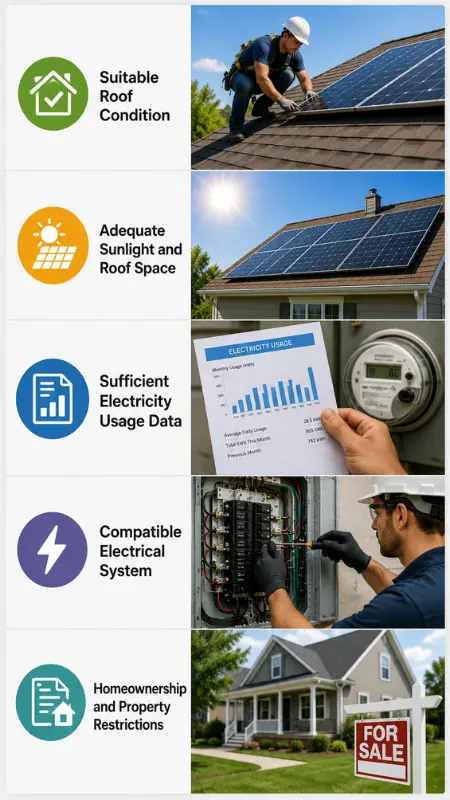
Before a solar company can design your system, several site-specific factors have to check out first. Installers evaluate five core requirements before finalizing any proposal,roof condition, sunlight access, energy usage, electrical compatibility, and property eligibility. Understanding these upfront helps you spot a rushed, generic quote versus one genuinely built on your home’s actual conditions.
1. Suitable Roof Condition
Your roof needs to structurally support the added weight of panels and mounting hardware for decades, not just today. Installers check the roofing material, age, and remaining lifespan before moving forward with any design.
- A roof nearing replacement should be handled first, not after installation
- Asphalt shingles, metal, and tile all mount differently, affecting labor and cost
- Structural soundness matters more than surface appearance or curb appeal
2. Adequate Sunlight and Roof Space
Panels need consistent, unobstructed sun exposure to perform as promised throughout the year. Solar Installers assess roof orientation, pitch, and any shading from trees, chimneys, or neighboring structures all factors that directly affect how much usable roof space your final system design can realistically work with.
3. Sufficient Electricity Usage Data
A system sized without real consumption data is essentially a guess, not an engineered design. Installers request several months ideally a full year of utility bills to understand seasonal usage patterns, ensuring the proposed system matches actual household demand rather than a generic, assumed average.
4. Compatible Electrical System
Older homes sometimes have electrical panels that can’t safely handle a new solar connection without upgrades. Installers inspect your main panel, wiring, and grounding to confirm compatibility, flagging any necessary electrical work before the system can be safely installed and connected to the grid.
5. Homeownership and Property Restrictions
Installing solar isn’t purely a technical decision, ownership status and local rules matter just as much. Renters generally need landlord approval first, and homes in HOA communities may face design or placement guidelines, even in states where law limits how much an HOA can actually restrict solar installations.
Roof Requirements for Solar Panels
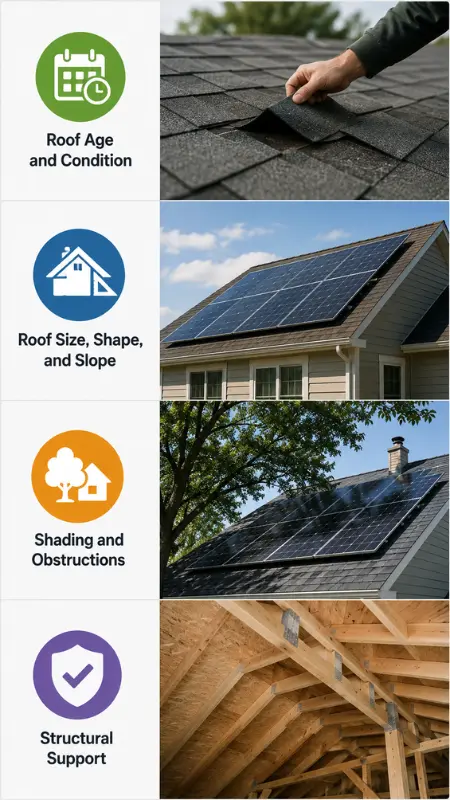
Your roof is the foundation of the entire solar project, and installers evaluate it long before any panels arrive. Four factors determine whether your roof is truly ready: its age and condition, physical dimensions, exposure to shading, and structural capacity. Each one shapes not just feasibility, but system size, layout, and long-term performance.
1. Roof Age and Condition
A roof’s remaining lifespan matters more than its current appearance. Most installers recommend at least 15-20 years of life left before installation, since removing and reinstalling panels for a future roof replacement adds significant cost.
- Asphalt shingles last 20-25 years
- Metal roofing can outlast most solar warranties entirely
- Existing leaks or damage should be repaired first, not worked around
2. Roof Size, Shape, and Slope
Usable roof area directly limits system size and how much electricity your home can generate. Installers measure available square footage, factor in fire-code setbacks along roof edges, and assess pitch panels perform well between 15 and 45 degrees, with 25 to 35 degrees considered ideal across most U.S. latitudes.
3. Shading and Obstructions
Even a well-positioned roof underperforms if trees, chimneys, vents, or neighboring buildings block sunlight during peak hours. Installers map shading patterns across the day and across seasons, since a spot that’s clear in summer can fall under shadow once the sun’s angle shifts in winter.
4. Structural Support
Panels, racking, and wiring add real weight around 3 pounds per square foot that your roof’s framing must handle safely for decades. Installers assess rafters, trusses, and overall load capacity, and homes built before the 1970s sometimes need reinforcement before installation can proceed.
Electrical Requirements for Solar Installation
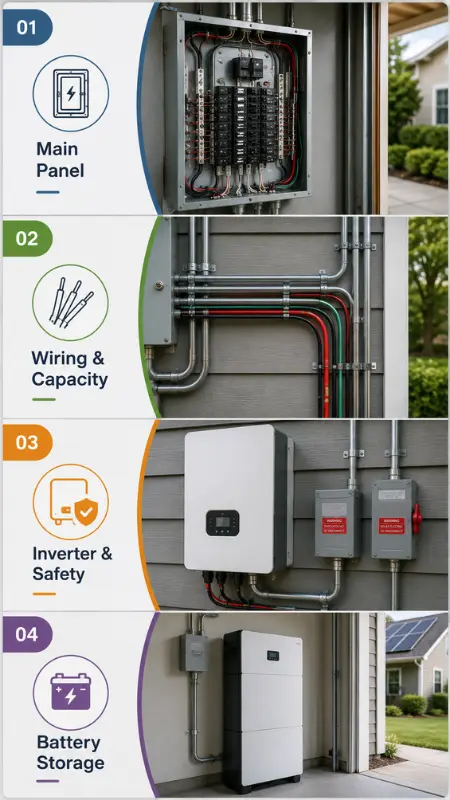
Your home’s electrical system has to safely handle the new connection, not just physically fit the panels. Four areas matter most: your main panel’s capacity, existing wiring, required safety equipment, and increasingly battery storage compliance. Each is governed by specific National Electrical Code (NEC) provisions that installers must document before a permit gets approved.
1. Main Electrical Panel
Most residential systems work best with a 200-amp main panel, since 100-amp panels often lack the headroom for solar plus future additions like an EV charger or battery. Installers calculate your panel’s available capacity against the new solar connection using NEC load calculations before approving any design.
- Panels rated 100A or lower frequently need upgrading first
- Busbar rating, not just panel age, determines actual capacity
- Upgrades typically require separate permitting from the solar work itself
2. Wiring and Electrical Capacity
Beyond the main panel, the wiring connecting your panels to your home’s electrical system must meet current ampacity and grounding standards. Older homes with aluminum wiring or outdated grounding sometimes require partial rewiring before a system can be safely interconnected, adding scope your original quote may not have priced in.
3. Inverter and Required Safety Equipment
Every grid-connected system needs an inverter to convert DC power into usable AC electricity, plus rapid shutdown equipment required under NEC 690.12. As of the current code cycle, conductors inside the array boundary must drop to 80 volts within 30 seconds of shutdown a firefighter-safety rule, not an optional add-on, and enforcement details vary by which NEC edition your local jurisdiction has adopted.
4. Battery Storage Requirements
Battery systems fall under NEC Article 706 and must carry system-level UL 9540 certification, not just cell-level listing. Residential installations are typically capped at 20 kWh per location under NFPA 855, with 3-foot spacing required between units and a dedicated disconnect separate from your solar system’s main disconnect.
Solar Panel Permit Requirements in the USA
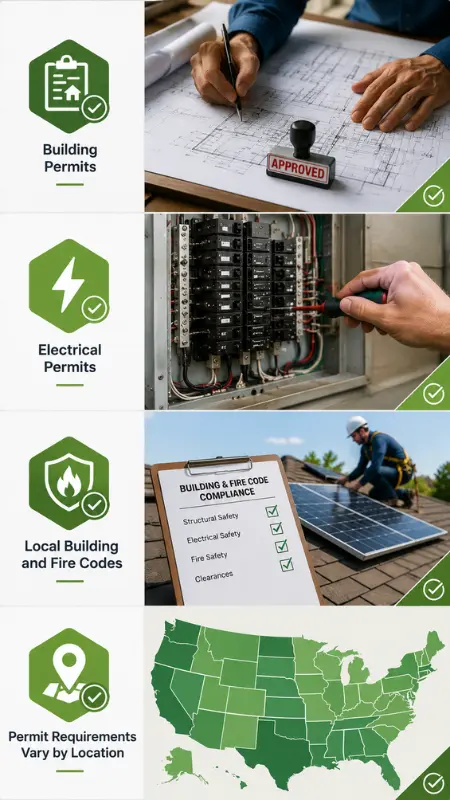
No residential solar system goes live without local government sign-off first. Every installation requires two separate approvals: a building permit and an electrical permit plus compliance with fire and building codes specific to your jurisdiction. What varies dramatically is how fast that approval actually happens, and that difference now runs into weeks, not days.
1. Building Permits
A building permit confirms your roof and mounting structure can safely support the array’s weight and wind load. Most jurisdictions require stamped structural drawings before approval, and this permit is separate from but processed alongside your electrical permit for the same project.
- Covers racking, mounting points, and structural load
- Typically requires a site plan showing panel placement
- Processed by your local building department, not the utility
2. Electrical Permits
This permit governs the wiring, inverter, and safety equipment connecting your system to your home’s electrical panel. Inspectors verify the installation meets current National Electrical Code requirements, including rapid shutdown compliance, before signing off a separate review from the structural building permit.
3. Local Building and Fire Codes
Beyond permits themselves, your installation must satisfy locally adopted building and fire codes, which determine equipment placement, spacing, and battery storage rules. Since code adoption isn’t uniform nationwide, a system compliant in one county can face different requirements just across a jurisdiction line.
4. Permit Requirements Vary by Location
Timelines, fees, and review steps all differ sharply by jurisdiction. Over 240 U.S. communities now use SolarAPP+, a free automated permitting platform issuing same-day or instant approvals for qualifying systems while traditional manual-review cities still take two to six weeks, sometimes longer for smaller jurisdictions.
- SolarAPP+ cities: often same-day approval
- Manual-review jurisdictions: typically 2-6 weeks
- Battery storage usually requires a separate permit, often carrying its own fee and adding review time
Utility Interconnection Requirements
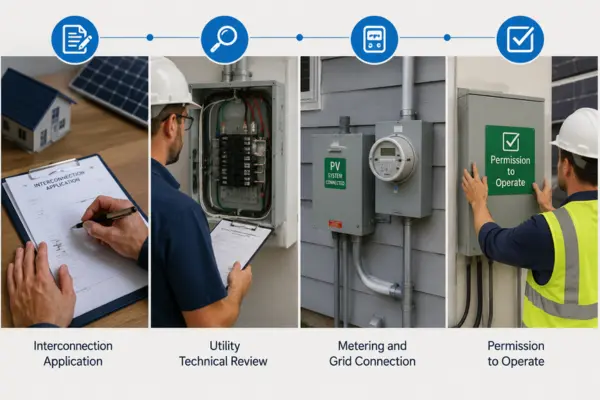
Connecting a residential solar system to the utility grid involves several steps to confirm that the system meets applicable electrical, safety, and interconnection requirements. Homeowners may need to complete an interconnection application, provide system details, pass the utility’s technical review, meet metering requirements, and receive Permission to Operate (PTO).
Requirements vary by utility and system design, so homeowners should check their utility’s current rules before installation.
1. Interconnection Application
The interconnection process begins with an application to the homeowner’s electric utility. The application may include the system size, electrical design, equipment specifications, inverter information, and other project details. The utility uses this information to determine whether the proposed solar system can safely connect to its distribution network.
2. Utility Technical Review
The utility reviews the proposed system to determine whether it meets applicable technical and safety requirements for grid connection. Depending on the system and utility, the review may consider equipment ratings, inverter specifications, electrical configuration, and potential impacts on the local grid. Additional documentation or design changes may be requested before approval.
3. Metering and Grid Connection
A grid-connected solar system may require a utility-approved meter or meter configuration that can properly measure electricity flowing between the home and the grid. The exact metering arrangement depends on the utility’s program and the system design. The installer typically coordinates the required electrical work and utility connection steps.
4. Permission to Operate
After the required installation, inspections, and utility procedures are completed, the homeowner may receive Permission to Operate (PTO) or equivalent authorization. This approval confirms that the system can be placed into grid-connected operation. Homeowners should not assume that installation alone means the system is authorized to operate with the utility grid.
HOA and Property Requirements
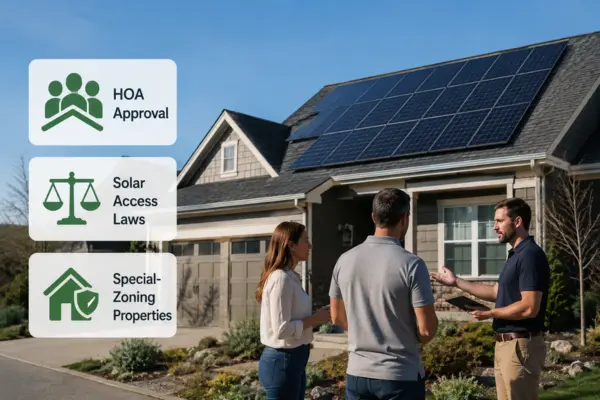
Before installing solar panels, U.S. homeowners should check whether any HOA, state, or local property rules apply to the project. These requirements can affect panel placement, approvals, and installation timelines. Checking them early helps homeowners avoid unnecessary changes after the solar system has already been designed.
1. HOA Approval
Living in an HOA community does not always mean you cannot install solar panels. However, the association may have rules about where panels can be placed, how visible they are, or how the installation is submitted for review. Check the HOA requirements before your installer finalizes the system design.
2. Solar Access Laws
Solar access rules can help protect a homeowner’s ability to use rooftop solar, but the protections depend on the state. Some states place limits on restrictions that could unnecessarily prevent solar installation. Check the rules that apply to your property before planning the panel layout.
3. Historic or Special-Zoning Properties
Extra requirements may apply if your home is inside a historic district or an area with special zoning rules. Local authorities may review changes to the roof or exterior appearance before approving the project. Ask the local planning or preservation office about any required review before installation.
Documents Needed for Solar Installation
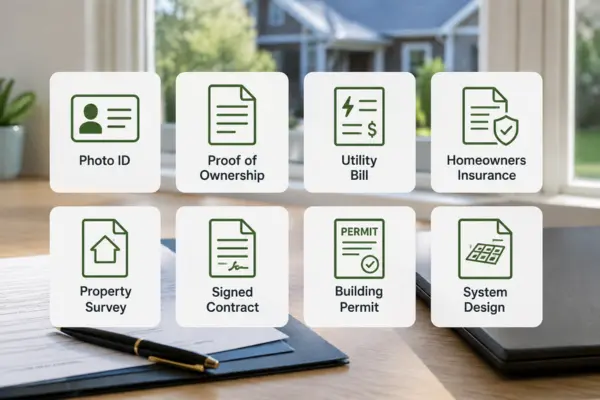
Homeowners often assume solar installation starts and ends with choosing a panel brand. In reality, four separate paperwork trails run alongside the physical work, one proving you own the home. One showing how the system is engineered, one certifying the equipment itself, and one granting legal permission to switch the system on. Skip any of these, and your installer can’t move forward, no matter how ready your roof is.
1. Property and Utility Information
Before a single panel touches your roof, the permitting office and your electric utility both want proof of two things: that you legally control the property, and how much power that property currently pulls from the grid. This step is largely paperwork you already have sitting in a drawer; it just needs to be gathered upfront instead of chased down mid-project.
- Deed or current mortgage statement confirming ownership
- Twelve months of electric bills, if your utility provides that history
- Utility account number tied to the service address
- Active homeowner’s insurance declaration page
- Written HOA sign-off, where an association governs the property
2. System Design and Electrical Plans
Once ownership is confirmed, attention shifts to how the system will physically sit on your roof and tie into your home’s wiring. Installers draft this technical package, but it’s worth understanding what’s in it. These are the documents a building inspector will actually study line by line before approving construction.
- Rooftop layout diagram marking exact panel positions
- Single-line electrical schematic showing the full circuit path
- Engineering calculation confirming the roof can bear the added weight
- Conduit and wire-routing map from panels to inverter
- Marked location for the inverter and required disconnect switches
3. Equipment Specifications
Permitting offices don’t take an installer’s word that equipment is safe. They want manufacturer paperwork proving it. This is one part of the process homeowners rarely touch directly, since installers submit it on your behalf, but knowing it exists helps you ask the right questions if your project stalls.
- Panel datasheet with UL safety listing
- Inverter spec sheet showing UL 1741 compliance
- Structural specs for the racking and mounting hardware
- Battery datasheet, when storage is part of the system
- Manufacturer warranty paperwork for each major component
4. Permit and Interconnection Documents
This final stack is what actually turns a finished installation into a working, legal power source. Nothing here is optional; your system stays dark until every document below is filed and approved.
- Approved building permit
- Separate electrical permit from the local authority
- Utility interconnection application
- Signed net metering agreement
- Permission-to-Operate (PTO) letter the utility’s final green light
What to Focus on a Professional Solar Installer?
Picking an installer is arguably a bigger decision than picking a panel brand the wrong contractor can mean permit delays, voided warranties, or a system that never gets utility approval. Before comparing quotes on price alone, homeowners should vet four things: whether the company is properly licensed, adequately insured, capable of handling local paperwork, and transparent about contract terms.
Licensing and Certification
- Valid state electrical contractor license
- NABCEP certification (industry gold standard)
- Manufacturer-authorized installer status
- Business registered and in good standing in your state
- Local business address, not just a call center
Insurance and Experience
- General liability insurance (minimum $1M coverage)
- Workers’ compensation insurance for the crew
- Years actively installing residential solar (not just sales)
- Number of completed installations in your area
- Verifiable references or reviews from local customers
Permit and Utility Coordination
- Handles building permit filing on your behalf
- Manages utility interconnection application
- Familiar with your specific city/county permitting process
- Secures the before final payment
- Clear timeline for permit and inspection steps
What to Check Before Signing
- Written, itemized quote (not a verbal estimate)
- Equipment brand, model, and warranty terms specified
- Workmanship warranty length (ideally 10+ years)
- Cancellation policy and payment schedule
- No pressure to sign same-day
Solar Installation Inspection and Final Approval
Mounting the last panel isn’t the finish line, it just means the system is physically done. Before it can actually turn on and start powering your home, it still has to clear a local inspection, survive any corrections that come up, get the utility’s blessing, and receive one final piece of paper. Here’s what each step actually looks like.
Local Inspection
- Happens once your installer says the physical work is complete
- Inspector eyeballs the wiring, grounding, and how panels are mounted
- Checks that what’s on your roof actually matches the approved permit
- Makes sure disconnect switches are labeled the way code requires
- Also checks roof penetrations so nothing’s set up to leak later
Corrections and Reinspection
- If something’s off, your installer fixes it this part isn’t on you
- Usually small stuff: a label missing, grounding not quite right, conduit too close together
- Once it’s fixed, the inspector comes back for another look
- Nothing moves forward to the utility until this passes
- Don’t panic if this happens it’s a normal part of the process, not a red flag
Utility Approval
- Your utility now reviews the interconnection paperwork
- They confirm the system size matches what was originally approved
- Sometimes this includes a physical check of your meter or equipment
- Expect this to take anywhere from 2 to 4 weeks, depending on the utility
- Your system has to stay switched off the entire time
Permission to Operate
- This is the document that finally lets you flip the switch
- Only issued after both the inspection and utility approval are done
- Worth holding onto you will want it if you ever sell the house
- Once you have it, your system can legally send power to and pull power from the grid
- This is the actual end of the installation process, not the day the panels went up
Frequently Asked Questions
Do I need a permit to install solar panels?
Yes. Nearly every U.S. municipality requires both a building permit and a separate electrical permit before installation can begin. Skipping this isn’t just risky, it can void your warranty and block utility approval later.
Does my roof need to meet specific requirements?
Yes. Installers look for a roof with at least 10–15 years of remaining life, enough structural strength to hold the added weight, and ideally a south-facing angle between 15–40°. Roofs that don’t meet these won’t automatically get rejected, but they may need repairs first or produce lower output.
Can solar panels be installed on an older roof?
It depends on how much life is left, not just the age. A roof nearing the end of its lifespan usually needs replacing before panels go up, removing and reinstalling a system later to fix a roof underneath costs far more than doing it upfront.
Does my electrical panel need an upgrade?
Sometimes. Older homes, especially those with a 100-amp panel, often don’t have enough spare capacity for a new solar circuit. An electrician can confirm this during the site assessment, and if an upgrade is needed, it’s usually priced separately from the solar quote.
Does my utility need to approve my solar system?
Yes, always. Every grid-tied system needs utility approval through an interconnection agreement before it’s legally allowed to operate. This step alone can take 2–4 weeks, and the system must stay off until approval comes through.
Do I need HOA approval for solar panels?
It depends on where you live. Some HOAs require a review before installation, but many U.S. states have laws limiting how much an HOA can restrict solar. So, an HOA usually can’t outright deny a system, though it may have rules about placement or appearance.
Do I need a battery with solar panels?
No, a battery isn’t required. Most grid-tied systems work fine without one. A battery becomes worth considering if you want backup power during outages or live somewhere with low compensation for excess solar exported to the grid.
Conclusion
Installing solar isn’t complicated once you know the sequence: confirm your roof and electrical panel can handle it, gather the right paperwork, hire a properly licensed installer, and expect the process permits, inspection, and utility sign-off included to take 6 to 12 weeks from contract to activation. None of these steps are optional, and skipping one is usually what causes the delays homeowners complain about most. Go in knowing what’s required, and the process is far more predictable than it looks on paper.