Every year, thousands of American homeowners make one of the biggest financial decisions of their lives: installing solar panels. But here’s the painful truth: a great solar panel means nothing if the installer gets it wrong. Faulty wiring. Roof leaks. Failed inspections. Systems that never perform as promised. These are not rare horror stories they happen every single day across the USA, costing homeowners thousands of dollars in repairs, lost energy savings, and sleepless nights.
So how do you make sure it doesn’t happen to you?
The North American Board of Certified Energy Practitioners (NABCEP) is widely recognized as the gold standard for solar installer certification in the United States. When a solar installer carries a NABCEP credential, it means they have passed rigorous training, logged real field experience, and committed to a strict code of ethics, so you don’t have to take anyone’s word for it.
That’s exactly why we created this guide.
In this article, you’ll find:
- A clear breakdown of what NABCEP certification actually means.
- The top NABCEP-certified solar installers across the USA in 2026.
- A simple step-by-step process to verify any installer’s credentials.
- The right questions to ask before signing any contract.
- State-by-state guidance on where NABCEP certification is required.
Whether you’re in California, Texas, Florida, or anywhere in between, this guide will help you find a trusted, verified solar professional who gets the job done right, the first time.
NABCEP (North American Board of Certified Energy Practitioners) is the USA’s most trusted nonprofit certification body for solar installers, established in 2002. A NABCEP-certified solar installer has completed approved training hours, accumulated hands-on field experience, passed a rigorous proctored examination, and committed to a strict code of ethics. It makes them the most qualified professionals for residential solar installation in the United States.
What Is NABCEP Certification and Why Does It Matter
A homeowner in California lost $4,200 in state rebates simply because their installer wasn’t NABCEP certified. Don’t let this happen to you. NABCEP’s PV Installation Professional (PVIP) certification has been accredited to the international ISO/IEC 17024 standard since 2007, the same global benchmark used for professional certification bodies worldwide. That’s not just a local badge, it’s a globally recognized mark of excellence.
Who Is NABCEP
If you’ve spent any time researching solar installation in the USA, you’ve probably come across the term NABCEP. But what exactly is it, and why does everyone in the solar industry keep talking about it?
NABCEP stands for the North American Board of Certified Energy Practitioners. Founded in 2002, it is a nonprofit organization built with one clear mission to raise the bar for quality and professionalism in the renewable energy industry across North America.
Think of NABCEP the way you think of a medical board for doctors or a bar association for lawyers. Just as you wouldn’t trust a surgeon without proper credentials. You shouldn’t trust just anyone to install a solar system on your home.
Today, NABCEP is universally recognized as the gold standard for solar certification in the United States. Utilities, state governments, employers, and homeowners across the country rely on NABCEP credentials to identify professionals who truly know their activity. In fact, several states have made NABCEP certification either preferred for solar rebate eligibility. It tells you everything about how seriously the industry takes it.
With over 18,000 certified professionals across the country. NABCEP has become the most trusted name in renewable energy certification, and for very good reason.
What Does NABCEP Certified Mean for Solar Installers?
Here’s where most homeowners get confused: they assume that any solar installer who shows up with a license is qualified. That’s not always true.
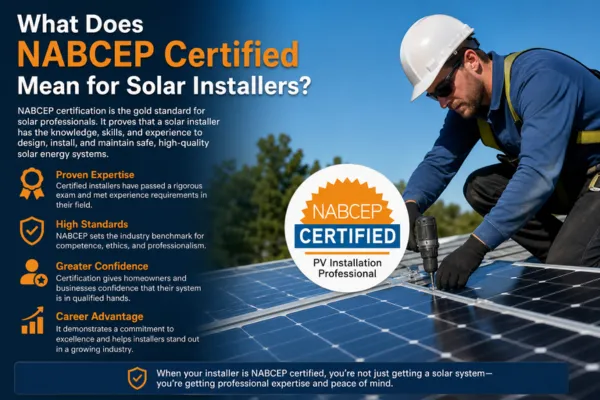
Getting NABCEP certified is not easy. It is not a weekend course or a simple online quiz. To earn a NABCEP credential, a solar professional must:
- Complete extensive training hours from an approved education provider.
- Accumulate real-world field experience in solar installation.
- Pass a rigorous, proctored examination that tests both technical knowledge and practical skills.
- Agree to follow NABCEP’s strict Code of Ethics and Standards of Conduct.
- Complete continuing education to maintain their certification over time.
What this means for you as a homeowner is simple: when a solar installer holds a NABCEP credential, they have already proven their competence before they ever set foot on your roof. They understand electrical systems, structural safety, local building codes, and proper installation techniques at a professional level. There are also multiple levels of NABCEP certification requirements depending on the role:
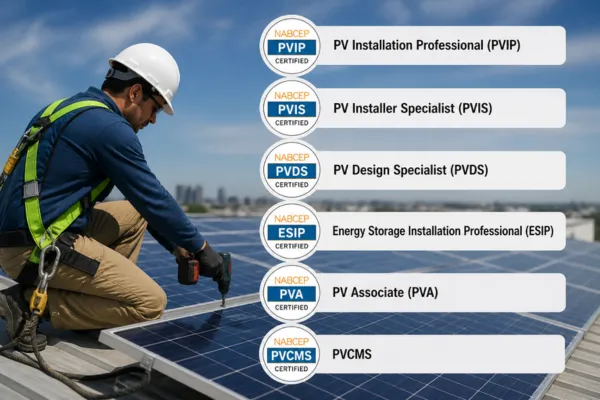
- PV Installation Professional (PVIP): The highest and most recognized credential for solar installers
- PV Installer Specialist (PVIS): For professionals specializing in the hands-on installation process
- PV Design Specialist (PVDS): For those focused on system design
- NABCEP PV Associate: An entry-level credential for newer professionals
Each level represents a different depth of expertise so when you’re hiring, always ask which specific NABCEP credential your installer holds.
Comparison: All NABCEP Certifications at a Glance
| Certification | Focus Area | Best For Homeowners When… |
| PVIP | Full installation lifecycle | Always — this is the must-have |
| PVIS | Hands-on physical installation | Large or complex roof installations |
| PVDS | System design & engineering | Maximizing energy output |
| ESIP | Battery storage systems | Adding home battery backup |
| PV Associate | Foundational knowledge | Entry-level, under PVIP supervision |
Why Homeowners Should Always Choose a NABCEP Certified Installer
Let’s be honest, solar installation is a major investment. The average American homeowner spends between $15,000 and $30,000 on a residential solar system. That’s not a decision you want to leave in the hands of someone who learned on the job last summer.
Here’s why choosing a certified solar professional in the USA is simply non-negotiable:
1. Your Money Is Protected
NABCEP-certified solar installers are held to a strict code of ethics. If something goes wrong, there is an actual accountability system in place. With non-certified installers, you often have no recourse when things go south.
2. Your Rebates May Depend on It
Several states, including Minnesota, Maine, and Wisconsin, require NABCEP certification for your solar system to qualify for state rebate programs. Hiring an uncertified installer could mean losing thousands of dollars in incentives.
3. Your Home Is Safer
Improper solar installation can cause roof damage, electrical fires, and failed inspections. A NABCEP certified roof top solar installer knows exactly how to handle every step from roof assessment to final grid connection safely and correctly.
4. Your System Will Actually Perform
A poorly installed solar system doesn’t just look bad, it underperforms. NABCEP-certified professionals ensure your panels are positioned, wired, and configured to generate maximum energy output for your specific home.
5. Your Investment Lasts Longer
Quality installation directly impacts the lifespan of your solar system. Most solar panels are designed to last 25–30 years, but only if they’re installed correctly from day one.
Choosing a NABCEP-certified solar installer is not about paying more for a fancy certificate. It’s about protecting your home, your money, and your family while making sure your solar system delivers every dollar of value it promises.
Types of NABCEP Certifications for Solar Installers
Not all NABCEP certifications are the same, and that’s actually a good thing for you as a homeowner. Think of it like a hospital. A general surgeon, a cardiac specialist, and an anesthesiologist all work together, but each has a very specific area of expertise. NABCEP works the same way.
Different certifications exist for different roles within the solar installation process, so every part of your project is handled by someone who has been specifically trained and tested for that exact job. Here’s a complete breakdown of every NABCEP certification that matters when you’re hiring a solar installer in the USA.
1. PV Installation Professional (PVIP)
If there’s one certification you should always look for when hiring a solar installer, it’s this one.
The NABCEP PVIP certification, short for Photovoltaic Installation Professional, is the most prestigious and widely recognized credential in the entire US solar industry. It has been the benchmark for professional solar installation since 2003, and in 2007. It became accredited to the international ISO/IEC 17024 standard. The same global framework is used for certifying airline pilots and medical professionals.
To earn the PVIP credential, a solar professional must:
- Complete a minimum of 58 advanced training hours from an NABCEP-approved provider
- Accumulate substantial hands-on field experience in real solar installation projects
- Pass a comprehensive proctored exam covering PV design, installation, commissioning, operations, and maintenance
- Renew their certification regularly through continuing education
What makes PVIP truly special is its scope. A PVIP-certified installer doesn’t just know how to put panels on a roof; they understand the entire solar system lifecycle, from initial site assessment and electrical design all the way through to grid connection and long-term maintenance.
Note: When getting quotes, always ask Do you hold a current NABCEP PVIP certification? Then verify it yourself on the NABCEP Professional Directory. Don’t just take their word for it.
2. PV Installer Specialist (PVIS)
While the PVIP covers the full picture, the solar PV installer specialist credential drills deep into the hands-on, physical side of solar installation, and it’s equally important.
The NABCEP PV Installer Specialist (PVIS) certification is designed for professionals who specialize specifically in the mechanical and electrical installation process itself. This includes:
- Installing DC and AC PV system conductors and raceways
- Setting up system monitoring, control, and communication hardware
- Executing proper roof penetrations and mounting systems
- Develop and follow job site safety plans
Think of the PVIS certified professional as the expert who ensures your panels are physically installed with precision, every bolt, every wire, every bracket done exactly right. In larger solar companies, you’ll often find PVIP-certified project managers working alongside PVIS-certified installation crews — a combination that delivers both strategic oversight and technical execution.
For residential homeowners, a company that employs both PVIP and PVIS certified professionals is a strong indicator of a truly high-quality operation.
3. PV Design Specialist (PVDS)
Here’s something most homeowners don’t realize: how your solar system is designed matters just as much as how it’s installed.
The wrong system size, poor panel placement, or incorrect electrical configuration can cost you thousands of dollars in lost energy production over the life of your system — even if the physical installation looks perfect.
That’s where the NABCEP PV Design Specialist (PVDS) comes in.
This certification recognizes professionals with advanced expertise in configuring the mechanical and electrical design components of PV systems. A PVDS-certified designer will:
- Analyze your home’s energy consumption patterns
- Calculate the optimal system size for your specific needs
- Design panel layout for maximum sun exposure
- Engineer the electrical configuration for peak efficiency
- Ensure the design meets all local code and utility requirements
Note: A well-designed solar system can outperform a poorly designed one by 20–30% in annual energy production even with identical panels. The design is where your savings are won or lost.
4. Energy Storage Installation Professional (ESIP)
Solar panels alone are impressive, but paired with a battery storage system, they become truly powerful. And as more American homeowners move toward energy independence, battery storage is no longer optional, it’s becoming essential.
5. NABCEP PV Associate (PVA) – Entry Level
This is the starting credential for beginners. It proves foundational knowledge in PV systems after completing approved training. No extensive experience is required. Many use it as a pathway toward professional certifications like PVIP.
6. NABCEP PV Commissioning & Maintenance Specialist (PVCMS)
Emphasizes testing, commissioning, troubleshooting, and long-term operations & maintenance (O&M) of solar systems. Highly relevant for installers who also handle system upkeep and performance optimization
The solar energy storage certification, officially called the Energy Storage Installation Professional (ESIP) validates a professional’s competence to safely design, install, and commission battery-based energy storage systems alongside solar PV setups.
Why Does This Matter for You?
Because installing battery storage is not the same as installing solar panels. It involves high-capacity battery systems, complex electrical configurations, and specific safety protocols that go far beyond standard solar installation. An ESIP-certified professional has been specifically trained and tested to handle all of it safely and correctly.
If you’re planning to add a Tesla Power wall, Enphase IQ Battery, or any other home battery system to your solar installation, make sure your installer holds either an ESIP certification or works with someone who does.
Note: With extreme weather events increasing across the USA, home battery storage installations have surged by over 40% since 2022. Hiring an ESIP-certified professional is no longer a luxury — it’s a smart necessity.
NABCEP PV Associate Credential (Entry Level)
Not every great solar professional starts with a full board certification and NABCEP recognizes that.
The NABCEP associate credential is an entry-level recognition designed for individuals who are newer to the solar industry but have already demonstrated a solid foundational understanding of PV systems. It’s the starting point of the NABCEP career pathway.
To earn the PV Associate credential, a candidate must:
- Complete approved solar training from an NABCEP-recognized provider
- Pass an associate-level examination covering grid-direct and battery-based PV systems
- Demonstrate knowledge of installation principles, safety, and system fundamentals
So what does this mean when you’re hiring?
An installer with only a PV Associate credential is not the same as one with a full PVIP certification. The Associate credential shows foundational knowledge, but it does not replace the years of field experience and advanced testing required for board certification.
That said, don’t dismiss associate-credentialed installers entirely. Many excellent solar companies employ associate-level technicians who work under the direct supervision of PVIP-certified professionals a structure that works well and maintains quality. The key question to ask is: Who on your team holds full NABCEP board certification, and will they be directly overseeing my installation?
Top NABCEP Certified Solar Installers in the USA in 2026
Finding a great solar installer in the USA isn’t just about googling solar company near me and picking whoever shows up first. The difference between a good solar installation and a great one often comes down to one thing, whether the people on your roof actually know what they’re doing.
That’s why we’ve done the hard work for you. The following list focuses specifically on residential solar installation professionals who either hold NABCEP board certifications, NABCEP-certified staff, or have earned NABCEP company accreditation, broken down by region. So you can find the best solar companies near me, no matter where you live in the USA.
| Region | Top Pick | NABCEP Status | Best For |
| Northeast | PV Squared | Full Company Accreditation | MA homeowners wanting gold standard |
| Northeast | Trinity Solar | NABCEP-certified staff | NY/NJ tri-state area |
| Southeast | Castaways Energy | NABCEP-certified contractor | Florida local expertise |
| West Coast | Elite Roofing & Solar | PVIP-only hiring policy | CO/AZ quality-first buyers |
| West Coast | Sunrun California | NABCEP-certified teams | CA NEM 3.0 navigation |
| Southwest | Freedom Solar Power | NABCEP + SunPower dealer | Texas premium installations |
| Midwest | Solar Energy Solutions | 7 NABCEP certifications | OH/IL/IN comprehensive coverage |
Note: NABCEP certifies individual professionals, not companies. However, the best solar companies employ NABCEP-certified installers on their teams. Always verify individual credentials at directories.nabcep.org before signing any contract.
Best NABCEP Certified Solar Installers by Region
The USA is a big country, and solar installation needs vary significantly by climate, state incentives, and local utility regulations. That’s why choosing a company with deep regional expertise matters just as much as checking their certifications. Here’s your region-by-region breakdown of the top solar installers in the USA in 2026.
Northeast: New York, Massachusetts, New Jersey
The Northeast is one of the most solar-incentive-rich regions in the entire country. New York’s NY-Sun Incentive Program specifically requires NABCEP-certified contractors for rebate eligibility, making certification non-negotiable here, not optional.
Trinity Solar
- Headquarters: Wall Township, New Jersey
- States Served: NY, NJ, MA, CT, PA, RI, DE, MD, FL
- NABCEP Status: NABCEP-certified installers on staff
Why They Stand Out
One of the largest family-owned solar companies in the USA, with over 100,000 installations completed. Trinity Solar brings a community-focused approach that national chains simply can’t match. Their teams are deeply familiar with local permitting requirements across all Northeast states, which means faster approvals and fewer headaches for homeowners.
Best for: Homeowners in the tristate area who want a proven regional expert over a faceless national brand.
ReVision Energy
- Headquarters: Portland, Maine
- States Served: ME, NH, VT, MA
- NABCEP Status: Multiple NABCEP-certified installers
Why They Stand Out
ReVision Energy is widely respected as one of New England’s most trusted solar companies. Their entire team philosophy is built around NABCEP standards. They don’t just employ certified professionals; they actively promote certification as a core company value. In Maine, where NABCEP certification is tied to state rebate eligibility, ReVision is a go-to choice.
Best For: Homeowners in northern New England who want deep local expertise and certified workmanship.
PV Squared
- Headquarters: Greenfield, Massachusetts
- States Served: MA, CT
- NABCEP Status: One of only 10 companies nationally with full NABCEP Company Accreditation
Why They Stand Out
PV Squared is not just a solar company. It’s a worker-owned cooperative, which means every employee has a personal stake in the quality of every installation. PV Squared proudly displays the NABCEP logo on all of its promotional materials pv magazine USA, and its commitment to certification is reflected in customer reviews that consistently praise installation quality above industry average.
Best For: Massachusetts homeowners who want the absolute gold standard, a company with full NABCEP accreditation, not just individual certifiers.
Note: Under the NY-Sun Incentive Program, your installer must be NABCEP-certified for you to receive cash incentives for residential systems up to 25kW. Always confirm certification before signing.
Southeast: Florida, Georgia, North Carolina
The Southeast, which historically lagged behind the West and Northeast in solar adoption, has seen rapid growth in recent years, and with that growth has come an explosion of solar companies, not all of them equally qualified. In this region, checking NABCEP credentials is more important than ever.
Castaways Energy
- Headquarters: Orlando, Florida
- States Served: Florida
- NABCEP Status: NABCEP-certified solar energy contractor
Why They Stand Out
With over three decades of combined industry experience, Castaways Energy builds both grid-tied and off-grid whole-home solar systems. They carry certifications from multiple manufacturers, including REC Solar and Tesla Energy, making them one of the most comprehensively certified installers in Central Florida. They also handle energy storage systems and EV charging stations, ideal for homeowners building a complete energy independence setup.
Best For: Florida homeowners who want an experienced, multi-certified local expert rather than a national chain.
Sunrun (Southeast Division)
- Headquarters: San Francisco, CA (Southeast operations)
- States Served: FL, GA, NC, SC, and more
- NABCEP Status: Employs NABCEP-certified professionals across regional teams
Why They Stand Out
Sunrun stood out as the best solar company overall in independent consumer analysis. In the Southeast specifically, Sunrun’s scale means faster permitting relationships with local utilities, a real advantage in states like Florida, where interconnection timelines can drag. They also offer one of the strongest lease and PPA programs, making solar accessible to homeowners who don’t want high upfront costs.
Best for: Southeast homeowners who want $0-down options, long-term service coverage, and the backing of the USA’s largest residential solar company.
Freedom Forever
- Headquarters: Temecula, CA (Southeast regional teams)
- States Served: NC, GA, FL, and 20+ states
- NABCEP Status: NABCEP-certified regional installation teams ✅
Why They Stand Out
Freedom Forever uses regionally focused installation crews — meaning your installer actually knows your local codes, climate conditions, and utility requirements. Their transparent pricing model means no surprise costs, and their production guarantee is one of the strongest in the industry.
Best For: North Carolina and Georgia homeowners who value transparent pricing and regional installation expertise.
Note: Florida has no state income tax credit for solar, but property tax exemptions and net metering make NABCEP-certified installations especially valuable. A properly designed and certified system ensures you maximize every available benefit.
West Coast: California, Oregon, Washington
California is the undisputed solar capital of the USA. It has the most competitive and complex installer market in the country. On the West Coast, NABCEP certification separates serious professionals from the flood of pop-up solar companies that appear during boom times.
Tesla Energy
- Headquarters: Austin, TX (West Coast operations heavily concentrated)
- States Served: CA, OR, WA, and nationwide
- NABCEP Status: Employs NABCEP-certified installation professionals
Why They Stand Out
Tesla’s solar offering, including Solar Panels, Solar Roof tiles, and Powerwall battery integration, is unlike anything else on the market. For California homeowners who already live in the Tesla ecosystem, the seamless integration between solar monitoring, home energy management, and vehicle charging is genuinely impressive. Their price-matching guarantee also ensures you’re getting competitive rates.
Best For: Tech-forward California homeowners who want cutting-edge design, seamless battery integration, and the reliability of a global brand.
Sunrun (California)
- Headquarters: San Francisco, CA
- States Served: CA, OR, WA
- NABCEP Status: NABCEP-certified installers on staff
Why They Stand Out
As a California-born company, Sunrun’s understanding of California’s complex utility landscape — CPUC regulations, NEM 3.0 net metering rules, SGIP battery incentives is second to none. Their Brightbox solar battery storage packages are among the most popular in the state, and their 25-year service guarantee for lease customers provides remarkable long-term peace of mind.
Best For: California homeowners navigating NEM 3.0 who want a company that truly understands the state’s evolving solar incentive landscape.
Solar Energy Solutions (Pacific Northwest)
- Headquarters: Pacific Northwest region
- States Served: OR, WA
- NABCEP Status: Multiple NABCEP certifications
Why They Stand Out
In Oregon and Washington, where solar adoption is growing rapidly but installer options are thinner than in California, companies that hold multiple NABCEP certifications stand out dramatically. Solar Energy Solutions employs licensed electricians at the Journeyman and Master levels alongside their NABCEP credentials, ensuring both solar and electrical code compliance on every installation.
Best For: Oregon and Washington homeowners who want locally rooted expertise with verified multi-certification credentials.
California Homeowner Tip: Under NEM 3.0, the value of solar export to the grid has changed significantly. A NABCEP-certified designer who understands California’s current net metering rules can optimize your system size for maximum financial return under the new rules.
Midwest: Illinois, Ohio, Michigan
The Midwest has emerged as one of the fastest-growing solar markets in the country. Midwestern states like Indiana and Ohio emerged as top-tier solar markets, driven by utility-scale projects and grid demand. For residential homeowners in Illinois, Ohio, and Michigan, finding NABCEP-certified contractors by state is particularly important because Illinois actually requires certification for anyone installing solar on someone else’s property.
Arch Solar (Arch Electric)
- Headquarters: Wisconsin
- States Served: WI, IL, MI, OH
- NABCEP Status: NABCEP-certified installation professionals
Why They Stand Out:
Founded in 2003, Arch Solar brings over two decades of Midwest-specific solar experience to every project. They handle both residential and commercial installations, and their deep familiarity with Midwest utility companies and local permitting processes means smoother installations and faster grid connections.
Best For: Wisconsin and Midwest homeowners who want a long-established local company with genuine regional expertise.
Solar Energy Solutions (Midwest)
- Headquarters: Midwest region (IL, IN, KY, OH, VA)
- NABCEP Status: Holds seven NABCEP PV certifications, the most in their region
Why They Stand Out:
This is one of the most impressively credentialed solar companies in the entire Midwest. Seven NABCEP certifications covering installation, design, commissioning, and more mean every aspect of your solar project is handled by a specialist, not a generalist. They are also a proud member of the Amicus Solar Cooperative, a network of 80 high-quality independent solar companies whose members average 20 years of industry experience.
Best For: Ohio, Indiana, and Illinois homeowners who want the most comprehensively certified installation team in the region.
Momentum Solar (Midwest expansion)
- States Served: OH, MI, and expanding Midwest presence
- NABCEP Status: NABCEP-certified professionals on installation teams
Why They Stand Out
Momentum Solar has built its reputation on customized solar power systems. They are genuinely tailored to each homeowner’s energy usage, not cookie-cutter designs sold at volume. In Michigan and Ohio, where energy costs and utility structures vary significantly by region. This customization approach consistently delivers better financial outcomes for homeowners.
Best For: Michigan and Ohio homeowners who want a fully customized system design backed by NABCEP-certified installers.
Illinois Homeowner Tip: Illinois law requires certification for solar installations on properties other than your own. Before signing any contract, confirm your installer’s NABCEP credential status directly, not just from the company’s website.
How to Find and Verify a NABCEP Certified Solar Installer Near You
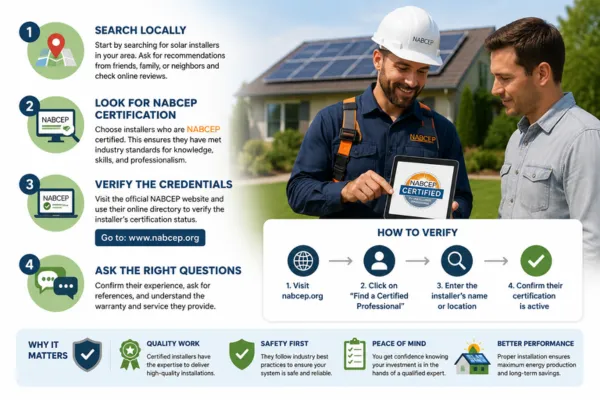
Installing solar panels is a big decision, so you want to make sure the work is done by a true expert. Finding a qualified professional is easy if you know where to look.
How to Find a Certified Pro
The best way to find a certified solar installer near me is to use the official NABCEP professional directory.
- Go to the NABCEP Professional Directory online.
- Use the search filters to type in your city, state, or zip code.
- This will show you a list of professionals in your area who have passed strict industry exams.
How to Verify Their Credentials
You should never trust a company’s word alone. It is important to verify solar installer certification yourself before signing any contracts.
- Ask for Proof: Ask the company for the full name and certification number of the person in charge of your installation.
- Check the Database: You can use the same NABCEP professional directory to look up that specific name or number.
- Confirm Status: Make sure their status is listed as active.
- Expert Check: Look for a PV Installation Professional who has the specific training needed for your home.
Why This Matters
Using a solar installer lookup USA tool ensures that your project is handled by someone who follows high safety and quality standards. Always check these details before you start. It is the best way to keep your home, your money, and your investment safe for many years.
NABCEP Certified Installers vs Non-Certified Installers: Key Differences
NABCEP-certified installers are trained professionals who have passed strict exams and follow industry standards, ensuring high-quality and reliable solar installations. Let’s compare them.
| Factor | NABCEP Certified Installers | Non-Certified Installers |
| Training & Qualification | Rigorous exam + verified field experience | Varies; no standard requirement |
| Certification Authority | Certified by NABCEP | No recognized national certification |
| Rebate Eligibility (USA) | Eligible for most rebates and incentives | Sometimes not eligible |
| Code of Ethics | Must follow strict ethical guidelines | No enforced code |
| Quality Assurance | High and consistent quality | Can be inconsistent |
| Compliance with Standards | Follows U.S. solar installation standards | May not fully comply |
| Customer Trust | Higher credibility and trust | Less predictable trust |
| Long-Term Performance | Better efficiency and reliability | Higher risk of issues |
| Inspection & Approval | Easier approvals and inspections | Possible delays or rework |
| Cost | Slightly higher upfront cost | Usually cheaper initially |
Frequently Asked Questions
What does a NABCEP-certified solar installer mean?
A NABCEP-certified installer is a solar professional who has passed industry-recognized exams and has real installation experience, ensuring high-quality and standard-compliant work.
How do I find a NABCEP-certified installer near me?
You can search through the official directory of NABCEP or check with local solar companies and ask for certification proof.
Is NABCEP certification required to install solar panels in the USA?
No, it is not legally required. However, many states and incentive programs prefer or require NABCEP-certified installers.
How long does NABCEP certification take?
It usually takes a few months to over a year, depending on your training, experience, and exam preparation.
What is the difference between NABCEP certified and NABCEP accredited?
- Certified: Refers to individual professionals who passed exams
- Accredited: Refers to training programs or institutions approved by NABCEP
Are NABCEP-certified installers more expensive?
They may cost slightly more upfront, but they often provide better quality, reliability, and long-term value.
Conclusion – Why NABCEP Certification Should Be Your #1 Priority
If you’re serious about a successful career in solar, NABCEP Certification should be your top priority. It’s the one credential that truly sets you apart by proving your real knowledge, skills, and commitment to quality. Employers trust it, clients respect it, and it often leads to better pay and more opportunities. In a fast-growing industry full of competition, NABCEP gives you credibility, confidence, and a real edge that no other training can match.