Solar panels can cost more than $20,000. For most homeowners, this is a once-in-a-lifetime purchase. That’s why the moment before you sign is the most important part of the whole process.
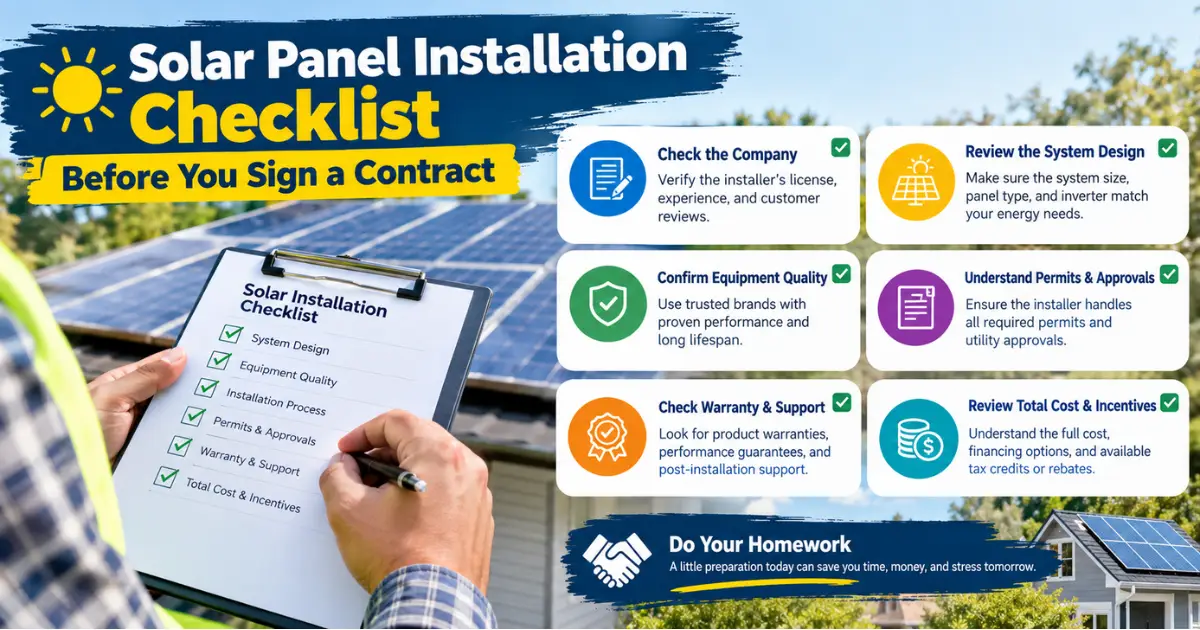
This checklist tells you exactly what to check, in the right order, before you put your name on any solar contract. We built it by studying real solar contracts, common installer mistakes, and the questions homeowners ask most often. Every fact here is checked against trusted public sources. The U.S. Department of Energy, the Federal Trade Commission, and state consumer protection offices not marketing claims from a solar company.
You don’t need to be an expert to use this guide. Just follow each step in order. By the end, you’ll know exactly what a fair solar contract looks like, and what red flags mean you should walk away. Let’s see the solar panel installation checklist at a glance that you must know and sign contact.
✨Installer & quotes
- Installer’s license verified with state board
- Insurance and bonding certificates collected
- At least 3 quotes compared with matching system size
- Cash price and financed price both provided
✨Technical details
- Exact panel, inverter, and battery models named in writing
- Roof, shade, and electrical panel inspected in person
- Production estimate checked against a public tool
✨Permits & legal
- Permits and HOA approval requirements confirmed
- Homeowner’s insurance company notified, if required
- 3-day right to cancel confirmed in writing
✨Financial terms
- Total loan or lease repayment cost calculated
- Escalator clause stated as an exact percentage
- Incentives verified through official sources
- Hidden dealer fees asked about directly
✨Contract & warranty
- Equipment and workmanship warranties documented separately
- Transfer-of-service clause reviewed
- Final contract matches the original proposal exactly
Step 1 Vet the Solar Installer Before You Request a Quote
Before you even talk numbers with a solar company, you need to know if that company is trustworthy. A shiny sales pitch doesn’t tell you if the installer will do good work or vanish after taking your money. This step is about checking the company itself, before anything else.
Verify License, Insurance & Bonding
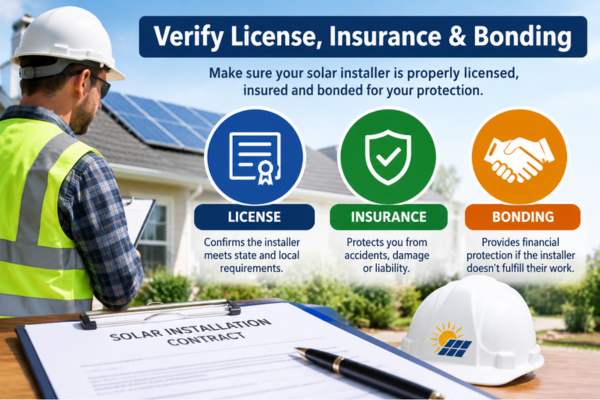
Look up the installer’s license on your state’s licensing board website, don’t just take their word for it. Ask for proof of general liability insurance (covers home damage) and workers’ compensation (covers injuries). And bonding (a guarantee that protects you financially if the installer leaves the job unfinished).
Check Complaints With State and BBB Records
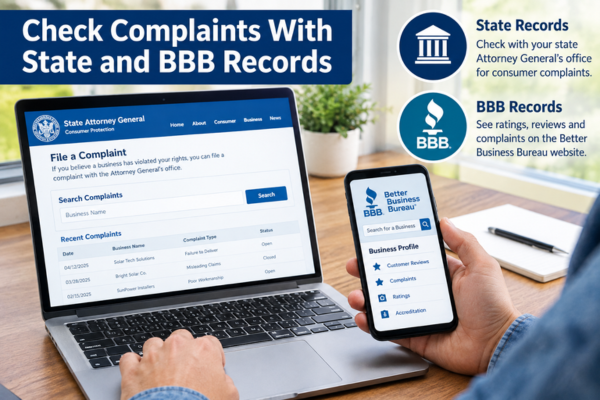
One complaint is normal. A pattern isn’t. Search the company name with “complaint,” and check your state’s consumer protection office and the BBB. Watch for unresolved jobs, billing mismatches, or a company that recently reopened under a new name.
Confirm Subcontracting Disclosure
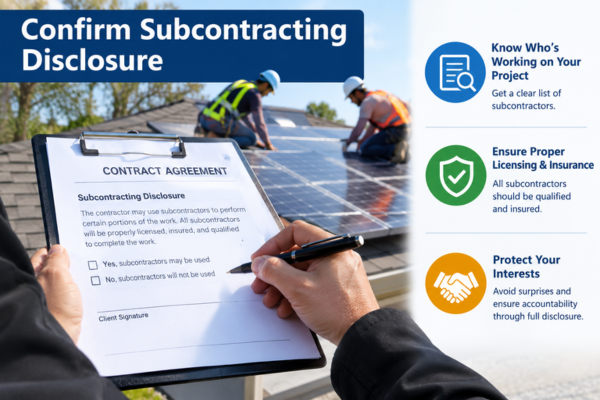
Some solar companies sell the job, then send a crew you’ve never vetted to install it. Just ask: “Will your own team install this, or will you subcontract it?“ Getting the answer in writing hesitation is itself a red flag.
Step 2 Compare at Least Three Quotes
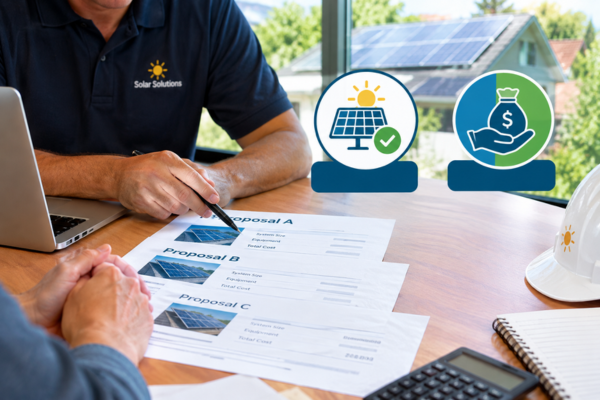
Never sign with the first company that shows up at your door. Solar installers price the exact same system very differently, sometimes by thousands of dollars. Getting at least three quotes is the simplest way to make sure you’re not overpaying and it also helps you spot which installer is being upfront with you.
Match System Size and Equipment Across Bids
A cheaper quote doesn’t always mean a better deal. Often, it just means a smaller system or lower-grade panels. Before you compare prices side by side, check three things on each quote: the system size in kW, the panel brand and wattage, and the inverter type. If one quote is for a 6kW system and another is for an 8kW system, comparing their total price tells you nothing useful.
Ask each installer to quote the same, or very similar, system size. This way, you’re comparing apples to apples instead of guessing which company is actually cheaper.
Ask for Cash Price vs. Financed Price
Always ask every installer for two separate numbers: the cash price and the financed price. Many people only see the financed price, usually shown as a low monthly payment, and never realize how much more they’re actually paying over time.
If the financed price is much higher than the cash price more than what normal loan interest would explain, that gap is often a hidden dealer fee. This fee gets added into your loan without being clearly labeled, quietly increasing your total cost. Asking this one question upfront can save you from an unpleasant surprise later.
Step 3 Confirm the Technical Details in the Proposal
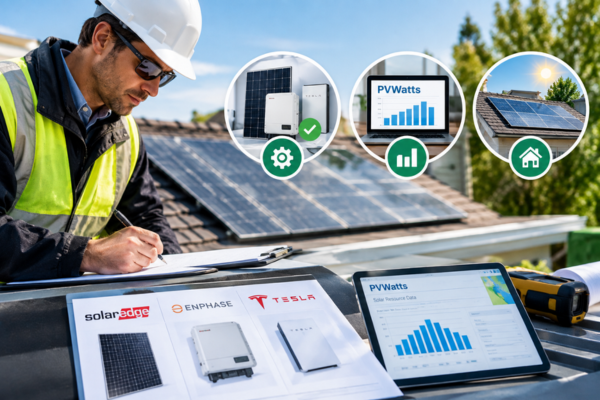
A good proposal doesn’t just list a price, it tells you exactly what you’re buying and why it will work for your home. If the details feel vague, that’s a warning sign.
Panel, Inverter & Battery Brand/Model Numbers
Your proposal should name the exact equipment being installed, not just words like premium panels or top-tier inverter. You want the actual brand, model number, and wattage for the panels, the inverter, and the battery if you’re getting one.
Why does this matter? Because vague terms can hide lower-quality equipment. Once you have the real model numbers, you can search them yourself and check things like efficiency ratings, warranty length, and how long that brand has been in business. If an installer won’t give you exact model numbers before you sign, ask why.
Production Estimate vs. a Public Benchmark (PVWatts)
Every proposal includes an estimate of how much electricity your system will produce each year. But installers sometimes stretch this number to make the savings look bigger than they really are.
You can check this yourself using PVWatts, a free tool made by the U.S. Department of Energy. Just enter your location and system size, and it gives you an independent estimate. If the installer’s number is far higher than what PVWatts shows for a similar setup, ask them to explain the difference before moving forward.
Roof Condition, Shade Analysis & Site Assessment
A trustworthy installer physically checks your roof, your electrical panel, and the shade around your home before giving you a final price, not just a photo from Google Maps.
Roof age matters, because you don’t want to install panels on a roof that will need replacing in a few years. Shade from trees or nearby buildings can quietly cut your system’s output, even if it seems minor. And your home’s electrical panel needs to be able to safely handle the new solar connection. If an installer skips this step and gives you a firm price without ever visiting, that’s a sign to slow down.
Step 4 Confirm Permits, HOA Approval & Insurance Notification
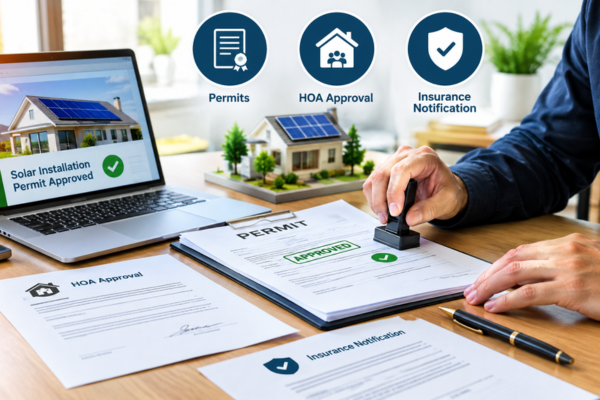
This is a step many homeowners forget about, and that’s exactly why it deserves its own place in this checklist. Skipping it can cause delays or unexpected costs after installation has already started.
Solar Panel Permits
Most solar installations need a permit from your local building department before any work begins. A reliable installer handles this for you, but you should still confirm who is responsible and roughly how long approval usually takes in your area. Permit delays are common, and knowing this upfront helps you set realistic expectations instead of being caught off guard.
HOA Approval
If you live in a neighborhood with a homeowners association, check their rules before signing anything. Many HOAs require approval for solar panels, and some have specific rules about where panels can be placed or how visible they can be from the street. Getting this approval after installation is far more stressful than getting it first.
Homeowner’s Insurance Notification
It’s also worth contacting your homeowner’s insurance company before installation. Adding solar panels can affect your policy, and some insurers require you to update your coverage once the system is installed. A quick phone call now can prevent a coverage gap later, especially if something unexpected happens to your system down the road.
Step 5 Review the Financial Terms Line by Line
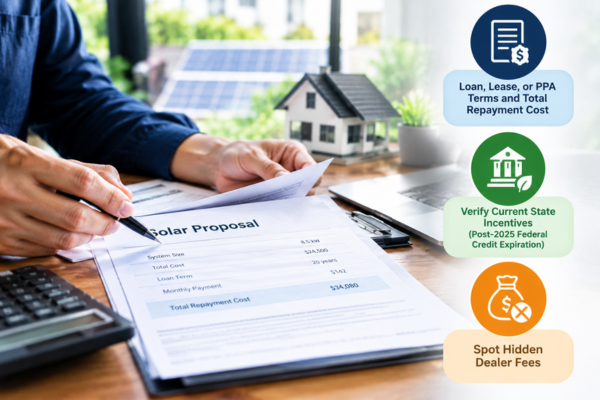
This is where the real cost of your solar system hides. A low monthly payment can look great on the surface, while the fine print tells a very different story.
Loan, Lease, or PPA Terms and Total Repayment Cost
Don’t just look at the monthly payment and ask for the full picture. If you’re taking a loan, get the interest rate, the loan length, and the total amount you’ll repay by the end. That total number often surprises people.
If you’re signing a lease or a Power Purchase Agreement (PPA) instead of buying the system outright, check for something called an escalator clause. This means your payment goes up a little every year. Make sure the contract states the exact percentage or dollar amount of that increase, not a vague phrase like “payments may rise over time.”
Verify Current State Incentives
The federal solar tax credit changed after 2025, so don’t assume the numbers a salesperson quotes you are still accurate. Incentives now vary a lot depending on your state, and some installers still use outdated figures from before the change.
Before signing anything, check your state’s current incentives yourself through an official government or utility website. This takes just a few minutes and protects you from planning your budget around savings that no longer exist.
Spot Hidden Dealer Fees
Ask this question directly: “Does this loan include a dealer fee?” Many solar loans quietly add one, and it gets rolled into your total loan amount instead of being shown as a separate charge.
This fee can add thousands of dollars to what you actually pay, even though your monthly payment looks the same. Asking about it upfront is the easiest way to make sure you’re not paying for something you never agreed to.
Step 6 Contract Clause Checklist: What Must Be in Writing

If a salesperson promised you something but it’s not written in the contract, it doesn’t count. This step is about making sure every important detail is actually on paper before you sign.
Scope of Work, Timeline & Permit Responsibility
The contract should clearly state who is responsible for pulling permits you or the installer. It should also give you a realistic timeline for the project, from installation day to the day your system is approved to turn on.
Ask what happens if permits get delayed or your utility company takes longer than expected to approve the connection. A good contract explains this instead of leaving you guessing.
Equipment and Workmanship Warranty Terms
You actually need two separate warranties, not just one. The first covers the equipment itself — the panels and inverter — and usually comes from the manufacturer. The second covers the installer’s own work, including anything they did to your roof.
Get the exact length of each warranty in writing, along with what could void them. A verbal promise like “it’s covered for years” means nothing if it’s not written down.
Cancellation and Transfer-of-Service Clause
Make sure the contract clearly explains how you can cancel, and by when. Most solar contracts signed at your home come with a legal right to cancel within a few days, so check that this right is stated clearly.
Also look at what happens if you sell your house later. Some contracts make it difficult for a new homeowner to take over your solar loan or lease, which can slow down or complicate a home sale. Reading this clause now can save you a major headache years from now.
Solar Installation Red Flags to Watch For
Location: Right after Step 6, before Know Your Legal Rights
- Pressure to sign the same day.
- No separate cash and financed price.
- Vague equipment descriptions with no model numbers.
- No in-person roof or site inspection before final pricing.
- A promised “zero electric bill” with no usage review.
- The final contract doesn’t match the original proposal.
Know Your Legal Rights Before You Sign
Beyond what’s in the contract, U.S. law gives you certain protections that no salesperson can take away — even if they don’t mention them.
The FTC’s Three-Day Cooling-Off Rule
If you sign a solar contract at your home, rather than at the company’s office, federal law gives you three business days to cancel it for any reason, with no penalty. This rule exists specifically to protect people from feeling pressured into a big decision on the spot.
Make sure your contract mentions this right clearly. If a salesperson tells you the deal expires the same day and pressures you not to think it over, that pressure itself is a red flag — a fair company won’t rush you past a right the law already gives you.
State-Level Solar Consumer Protections
Some states go further than the federal rule and give homeowners even more time or extra protections when it comes to solar contracts. Rules can also differ on things like required disclosures or how installers must present pricing.
Before you sign, take a few minutes to check your state attorney general’s or consumer protection office’s website for any solar-specific rules. It’s a small step, but it means you’re signing with full knowledge of exactly what protections you have.
You don’t have to remember all of this at once. Just come back to this checklist before you sign anything, and go through it step by step. A few minutes of checking now can save you from years of regret and a good installer won’t mind you taking the time to ask questions. If something feels rushed or unclear, that’s reason enough to pause.
FAQs
Can I cancel a solar contract after signing?
Yes. If you signed at home (not at the company’s office), federal law gives you 3 business days to cancel for any reason, no penalty.
Is the federal solar tax credit still available in 2026?
The federal credit changed after 2025 checks your state’s current program directly, since salespeople often quote outdated numbers.
Do I need HOA approval before installing solar panels?
If your neighborhood has an HOA, check their rules first and many require approval before installation begins.
What if the final contract doesn’t match the original proposal?
Don’t sign. Ask the installer to explain every difference in writing before you agree to anything.
Should I install solar panels myself or hire a professional?
Hire a licensed installer DIY solar involves electrical and roofing risk, and most warranties require professional installation.
Final Takeaway
A solar contract is one of the biggest purchases most homeowners will ever sign. Go through this checklist step by step, ask direct questions, and don’t let anyone rush you past your legal right to think it over. You don’t need to be an expert. Just slow down, ask the right questions, and get every promise in writing before you sign. If an installer pressures you to sign the same day, that tells you how they’ll treat you after the sale.