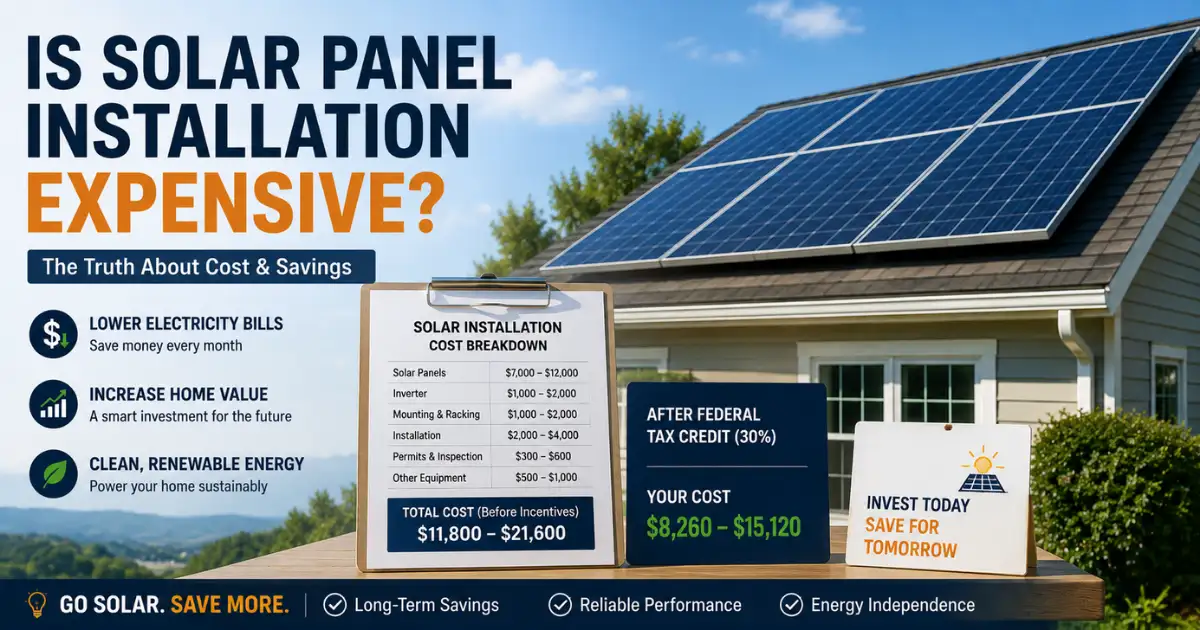
Many USA homeowners think solar panel installation is not as expensive. But in reality, the final cost depends on system size, state incentives, and available federal tax credits. For a residential system, the solar system set up upfront cost can range from $15,000 to $25,000. Most U.S. homeowners qualify for the 30% federal solar tax credit, which significantly reduces the final price. Therefore, state incentives, net metering benefits, and financing options make the solar system more affordable.
When long-term electricity savings are considered, solar panel installation often becomes a cost-effective investment. Solar panel installation in the United States is often perceived as expensive. For many U.S. homeowners, solar is now more affordable than ever.
How Much Does Solar Panel Installation Cost in the United States?
On average, solar panel installation in the United States costs between $15,000 and $25,000 before incentives for a typical residential system. The final price depends on your home’s energy needs, system size, staff cost, and the state you live in.
Average Solar Installation Cost in the USA
Here’s a simple breakdown most U.S. homeowners can relate to:
- Average cost per watt: $2.50 to $3.50
- System size: 5 kW to 8 kW
- National average before incentives: $18,000 to $22,000
Many Americans don’t pay the full cost upfront. Solar loans, leases, and $0 down payment options encourage U.S. homeowners to install solar panel in their home.
Is Solar Panel Installation Expensive in the United States?
No, solar panel installation in the United States is not as expensive as it appears. With the 30% federal solar tax credit and long-term savings on electricity bills, most U.S. homeowners find solar to be a cost-effective investment over time. Indeed, depending on the roof size, material cost, labor cost, and distance.
What affects your price most (USA)
- System size (kW) based on your electric bill
- Your state + local labor rates
- Roof type/condition
- Permits + utility interconnection
Simple calculation for Understanding cost per watt
In the U.S., residential solar is commonly priced around $2.50–$3.50 per watt (before incentives). Quick example (simple math):
- 6 kW system = 6,000 watts
- If $3.00/watt = $18,000 before incentives
Subtract the 30% Federal Solar Tax Credit
Most U.S. homeowners can claim the Residential Clean Energy Credit = 30% for eligible solar costs from 2022 through 2032.
Example:
- $18,000 system = 30% credit =$5,400
- New effective cost = $12,600 (before any state/utility perks)
Apply state/utility benefits
After the federal credit, your final cost can drop further depending on:
- Net metering/bill credits
- Local rebates
- State tax perks (in some states)
NOTE: for many Americans, solar stops feeling expensive when:
- A loan/financing option keeps the monthly payment near the electric bill
- The system reaches payback in years (not decades)
So, solar installation can look expensive upfront in the U.S., but after the 30% federal tax credit (and any state/utility benefits). It’s often much more affordable than people expect.
Is Solar Panel Installation Really Expensive Compared to Electricity Bills?
In the United States, solar panel installation is usually cheaper than paying electricity bills long-term, especially in states with high utility rates like California, New York, Texas, and Florida. Let’s see a comparison of solar panel installation and commercial electricity bill in the USA.
| Factor | Solar Panel Installation (USA) | Traditional Electricity Bills (USA) |
| Upfront Cost | $15,000 to $25,000 (before incentives) | $0 upfront |
| Cost After Incentives | $10,000 to $18,000 (after 30% federal tax credit) | Not applicable |
| Monthly Expense | Often equal to or lower than electric bill with financing | $130 to $170 per month |
| Cost Over 25 Years | Mostly fixed; panels produce free energy after payback | $35,000 to $45,000+ with rising utility rates |
| Price Stability | Locked-in energy cost for 25+ years | Rates increase over time |
| Break-Even Time | 6 to 10 years (varies by state) | No break-even; continuous payments |
| Long-Term Savings | High to thousands of dollars saved | None |
| Home Value Impact | Often increases home value | No added value |
An example is in front of you, and the choice is yours (which one would you choose, renewable energy or commercial natural energy).
Federal and State Incentives That Reduce Solar Costs
Solar panel installation in the United States is more affordable due to strong federal and state incentives. The most important incentive is the 30% Federal Solar Tax Credit (ITC), which allows homeowners and businesses to deduct 30% of their total installation cost from their federal income taxes through 2032.
Therefore, many U.S. states offer state-level incentives such as net metering, solar rebates, state tax credits, and performance-based programs like SRECs. These incentives reduce upfront costs, lower monthly electricity bills, and shorten the solar payback period.
Bottom line: When federal and state incentives are combined, solar installation costs in the USA can drop by 40%–60%, making solar a cost-effective option for many American households.
Federal Solar Tax Credit (ITC)
What it does? It allows homeowners and businesses to deduct a percentage of their solar installation costs from their federal taxes.
- Current rate: 30% tax credit through 2032 (applies to system cost including panels, inverters, labor, and permitting).
- How it works: If your solar system costs $18,000, you can reduce your federal tax bill by $5,400.
- Who qualifies: Most American homeowners and businesses installing solar energy systems.
State-Level Solar Incentives
Many states and local governments offer additional incentives that stack with the federal credit, further reducing solar costs. These vary widely by state, but common types include:
- State Tax Credits (New York Solar Tax Credits, New Mexico Solar Tax Credit).
- Net Metering Policies (California, New York, Massachusetts, Arizona).
- State Rebates and Performance Incentives.
Why Solar Panel Installation Costs Vary by State
Solar panel installation is not equally priced across the USA. Solar panel installation costs vary by state in the United States. This is because each state has different labor rates, permit fees, utility rules, and solar incentives. States with higher labor costs and stricter permitting, such as California and New York.
Often have higher upfront prices, while states with simpler regulations may cost less. Many solar power companies in the United States offer loans with a zero down payment. This privilege also help people to install solar panel at their homes and commercial areas.
Is Solar Panel Installation Worth the Cost in the United States?
Most US home says yes. For most homeowners in the United States, solar panel installation is worth the cost. With the 30% federal solar tax credit, state incentives, and rising electricity prices, many U.S. homeowners recover their investment within 6 to 10 years. After the payback period, solar panels can significantly reduce or eliminate monthly electric bills for 20+ years, making solar a cost-effective long-term investment.
When Solar Is Worth It?
Whenever you have a good plan of panel operation and maintenance, continuous cleaning for a better output power, etc. There are also some of the best plans to be worthy, such as
- Make a plan to stay in your home 7+ years.
- Live in a high electricity cost state.
- The roof receives good sunlight.
- Qualify for U.S. incentives.
Indeed, the Solar system also increases home value in many U.S. housing markets.
Can Solar Panel Installation Be Affordable with Financing?
Yes, solar panel installation can be affordable in the United States with financing options. Many U.S. solar companies offer payment plans, loans, leases, and Power Purchase Agreements (PPAs) that help spread out the cost over time, often making monthly payments similar to or lower than current electric bills. Many U.S. solar panel companies offer:
- $0 down solar loans
- Solar leases
- Power Purchase Agreements (PPAs)
Final Thought
Solar panel installation in the United States is not as expensive as it appears, especially after federal tax credits, state incentives, and long-term energy savings are considered. For many Americans, solar is a cost-effective investment that reduces energy bills and protects against rising electricity prices.
FAQs
Is solar cheaper than electricity in the USA?
Yes, in the USA, most states solar becomes cheaper than utility electricity over time.
How long does it take to break even on solar in the USA?
6 to 10 years, depending on location and incentives.
Does solar installation costs differ by U.S. state?
Yes, installation costs and savings vary significantly by state.