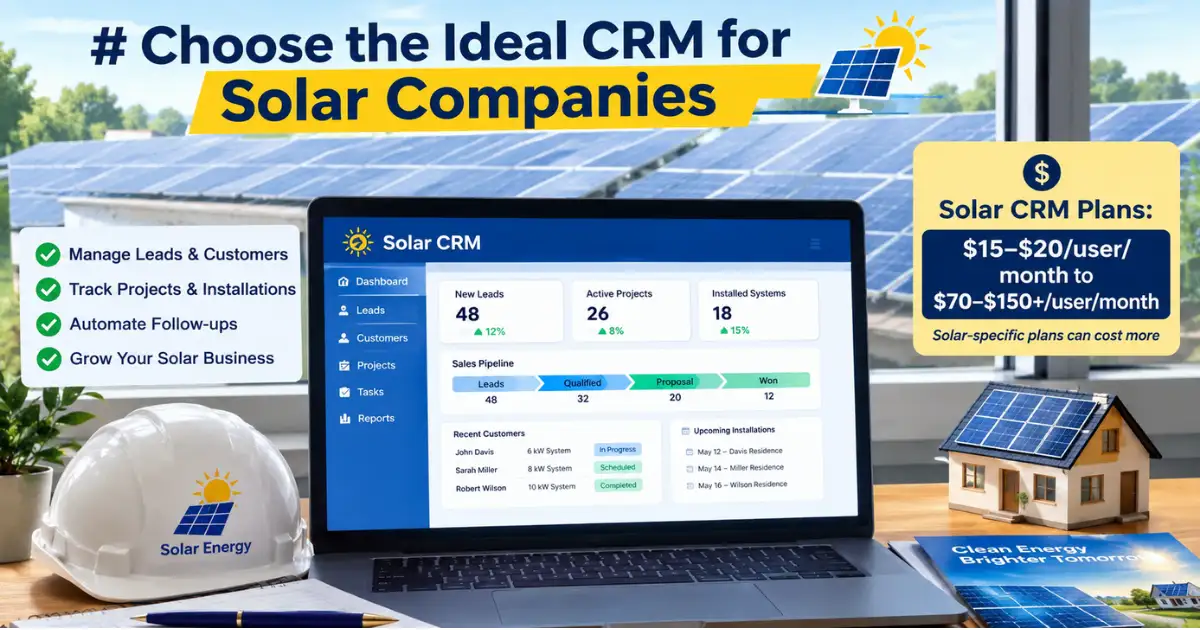
In 2023, the U.S. added roughly 32–40 GW of PV capacity, over half of the new power generation that year. The global solar growth is expected to drive about 80% of renewable energy expansion by 2030. Amid this boom, relying on spreadsheets and email threads just won’t scale. You will need a solar-specific CRM to manage data, automate tasks, and put leads on cruise control.
In this article, we will show how to select one that will improve your solar business. We’ll review the key features, mobile field apps, integration, cost flexibility, user-friendliness, and more. You’ll also discover why a solar-specific CRM is considerably more effective than generic platforms. Lastly, we will discuss why AI-driven CRMs are important than ever. This guide will help you choose the best solar CRM to boost sales growth, operational efficiency, and long-term client happiness.
Businesses using CRM report an average 29% bump in sales revenue and a 34% jump in sales productivity. But here is a twist. You must go through a buyer’s checklist of the must-have solar CRM features according to your business goals. In this article, we will discuss the key features to consider when choosing CRM solutions. It will guide you to the investment with the highest growth and efficiency. Let’s dive in!
How to Choose the Ideal CRM for Solar Companies
1. Feature Set Built for Solar Sales & Projects
Lead and Contact Management
Leads are the lifeblood of solar businesses. Your team must manage them effectively to ensure opportunities turn into sales. So, solar business CRM should capture leads from multiple sources like website, social campaigns, referrals, or door-to-door canvassing. Then, it should automatically store them in a central system. The CRM should also offer scoring tools to prioritize prospects by evaluating energy usage, roof orientation, and past interactions. This will help your sales teams focus on the most promising opportunities.
Sales Pipeline and Workflow Automation
Check if your CRM provides a visual pipeline because you should map every prospect’s journey from initial inquiry to signed contract. It should also offer automated reminders, SMS follow-ups, and email sequences. This will ensure no opportunity slips through the cracks. Lastly, it should build custom workflows around the company’s sales process. This will help shorten the sales cycle, increase responsiveness, and improve overall conversion rates.
Estimating and Proposal Tools
Faster, more accurate proposals give solar companies a competitive edge. So, ensure your CRM has estimating tools to help teams generate precise quotes. The quotes should be according to roof measurements, energy consumption, and available incentives. CRMs should also have integrated software such as Aurora Solar or HelioScope for detailed system layouts and production estimates. Also, search for proposal templates for professional and customisable branded documents.
Project and Installation Management
Check if your Solar CRMs provide project tracking tools to keep timelines on track. It should monitor every stage from site surveys to permits, inspections, and final grid connection in a single system. Besides, search for task assignments to ensure that responsibilities are clear for sales reps, surveyors, and installers. Also, it should have enough document storage to centralize contracts, blueprints, permits, and inspection reports. You can also opt for a customer portal to let your clients view progress updates, timelines, and site photos.
Communication and Customer Engagement
Make sure your CRMs make it easier to keep customers engaged. It should offer a central hub for calls, emails, and messages. This will help you to track all interactions without losing context. It is better to have an appointment option for booking consultations, surveys, and solar panel installations. This will reduce the back-and-forth that often slows projects. Your CRM should also offer self-service portals for clients for direct access to updates, documents, and timelines. This will ensure clear and continuous communication.
Reporting and Performance Analytics
You must have insights into your performance to drive continuous improvement. So, choose a CRM with advanced reporting tools. It will provide visibility into estimates, invoices, payments, rebates, financing, sales performance, conversion rates, and campaign ROI.
Customizable reports also allow managers to analyze project cycle times, task completion rates, and overall team productivity. Your CRM should also have forecasting tools that provide accurate revenue predictions. This extensive data will help you identify bottlenecks, refine processes, and make more informed decisions.
Document Management and Compliance
Solar projects generate a significant volume of paperwork. Your CRM should simplify this by offering secure document storage and compliance tracking. It should also offer automatic reminders for permit renewals, inspection dates, or upcoming deadlines. So, your teams will remain proactive rather than reactive. It will also prevent costly mistakes. Lastly, it will improve efficiency when coordinating with inspectors, utilities, and financial partners.
Service and Ongoing Maintenance
Ongoing service and maintenance are vital for long-term satisfaction and loyalty. So, your solar CRM should support warranty claims, preventive maintenance schedules, and service ticket tracking. With this streamlined service management, you can reduce downtime and resolve issues faster.
This will help to maintain strong customer relationships that often lead to referrals. By some estimates, AI-driven monitoring can reduce maintenance costs by 30–40% and cut system failures up to 70% in the field. It keeps customers happy and saves money.
2. Mobile Capabilities
Mobile usability in your CRM is non-negotiable for broader accessibility. Here are the mobile capabilities features with their benefits.
Mobile Access for Field Teams
Your CRM should allow reps and installers to access customer data, project details, and proposal documents directly from their smartphones or tablets. So, they will not have to wait until they return to the office to update records. This ensures clear, faster responses and fewer errors. It also ensures seamless communication between office staff and field workers.
Dashboards and Team Collaboration
Mobile dashboards and leaderboards, a version of a CRM, can give managers real-time insights into rep performance and pipeline health. Field reps can also log tasks, record voice notes, and share updates instantly with teammates. So, teams stay connected no matter where they are. This ensures smooth collaboration, faster problem-solving, and higher accountability. This also reduces after-hours admin work, freeing reps to focus on selling.
Offline Sync for Unstable Connections
A mobile CRM with offline functionality allows reps to record notes, upload site details, or capture utility bills without internet access. Once reconnected, the data syncs automatically. This ensures zero lost information and uninterrupted workflows. It can help your sales teams maintain professionalism in front of customers. So, you do not have to worry about boosting productivity in low-connectivity regions.
Push Notifications and Instant Alerts
Mobile option comes with push notifications that instantly alert reps to new leads. It can range from upcoming appointments to pending follow-ups. Instead of relying on manual check-ins, the app keeps them on track. So, reps can respond to leads up to 40% faster. It can significantly increase conversion rates and win more customers.
Geo-Aware Features and Smart Tracking
Geo-tagging and GPS-enabled features allow reps to map nearby leads, log site visits, and attach location-stamped photos. Installers can capture roof images, meter labels, or serial numbers directly through their mobile devices. Your team will have the proof of visits, precise project documentation, and better territory management. This fosters accuracy and accountability.
Photo and Document Uploads
CRM’s mobile accessibility allows one-tap uploads of files and images from roof photos to utility bills. Installers can take pictures of completed work. On the other hand, sales reps can attach bills and contracts during consultations. This ensures all documents are instantly stored and accessible. It reduces back-and-forth emails and paperwork delays.
Integrated Financing and Proposal Tools
Some CRMs include built-in financing calculators and digital proposal tools in their mobile versions. So, a rep can capture customer data, generate a personalized solar design, calculate savings, and share financing options during the initial visit. Contracts can even be signed on-site using mobile e-signature features. So, your customer gets everything in one visit.
3. Integration ability with Solar Tools
Solar panel installers juggle many tools like design software, financing portals, marketing platforms, project apps, and more. So, your solar CRM ties these together with vast integration. Here are a few key integrations every solar CRM should support:
Solar Design Tools
Your CRM should have integration with design tools like Aurora Solar or HelioScope. They will help site survey data, panel layouts, and system specs flow into your CRM and proposals without re-entry. This design-to-proposal link can cut soft costs dramatically. One industry survey found that design and project-management software can save up to 30% on expenses like permitting, logistics, and admin.
Financing & Accounting
Your CRM should link to QuickBooks, Xero, Sage, or ERP systems for instant financial dashboards and automated invoicing. Teams report up to 25% higher profit margins when accounting is integrated vs. using separate spreadsheets. Your CRM can even plug into solar financing portals so customers can apply for loans or PPAs directly from their proposal. Then, the approval status syncs back to your CRM.
Marketing Automation
Some companies have seen 3× revenue growth by combining CRM data with marketing automation. So, your CRM should connect with Google Ads, Facebook, email, and landing-page tools so leads flow in real time. Automated campaigns trigger the right messages to prospects, like email drips, retargeting ads, etc. Then, all responses are updated back in the CRM. Marketing teams can build campaigns up to 60% faster with these integrations. It will free them to focus on strategy instead of data entry.
Project Management & Inventory
Integration with project management software like Trello, Asana, Monday.com, or warehouse software is another plus. It will flag low inventory, trigger reorders, and automatically update project budgets. So, you can schedule changes or site updates to sync from the field to sales without extra emails or spreadsheets. This will help you to avoid costly delays.
Permitting & General Tools
Your CRM should connect to permitting software or municipal APIs so your CRM logs when permits are approved. It will eliminate the need to check websites or paperwork. You can even integrate common apps like Google Calendar and Zapier. In fact, CRMs with open APIs and connectors can tie into 3,000+ apps. It will make it easy to automate cross-system workflows and truly ensure one source of truth for every team member.
4. Easy User Interface & User Experience (UI/UX)
Poorly designed, cluttered systems discourage adoption and lead to wasted investment. A clean, intuitive design keeps teams engaged and ensures the system becomes part of their daily workflow. Here are the user interface features your CRM must have
Clean and Simple Dashboards
Your team should be able to log in and instantly see what matters most. For example, today’s tasks, hot leads, and at-risk deals. Choose the dashboard that highlights key metrics. It will reduce wasted time and keep everyone focused on results. Also, search visual charts and status indicators make it easy to act quickly.
Visual Pipelines and Role-Based Views
Your CRM should have Drag-and-drop pipelines to update deal statuses with minimal clicks. Also, search for custom role-based views to keep each screen relevant according to the role. For example, sales sees leads and quotes, operations tracks installations, and finance monitors payments. This keeps the CRM organized and user-friendly for every department.
Faster Training and Higher Adoption
If it takes weeks of onboarding, productivity will suffer. A user-friendly CRM reduces training needs so reps and project managers can hit the ground running. Search for CRMs that offer in-app coaching and contextual tips. This will guide new hires directly within the system. It can shorten learning curves and improve data quality.
Admin-Friendly Customization
Your CRM should have admin-friendly customisation as well. Non-technical admins should be able to create custom fields, validation rules, and automations without writing code. Easy customization makes the CRM flexible. It will also keep your data accurate without IT bottlenecks.
5. Pricing Flexibility
The price of your solar CRM must match your budget. Here are the CRM pricing factors you should consider
Matching CRM Costs to Business Size
Solar companies range from small local installers to national enterprises. That’s why flexible pricing is essential. Many companies offer tiered subscription plans. If you have a small company, you can start with lead management basics. If you have a larger company, you can upgrade to advanced features like AI tools, integrations, and custom reporting.
Common Pricing Models
Seat-based tiers are the most common, charging per user per month. Others use usage-based add-ons for things like e-signatures or SMS campaigns. Some CRMs offer bundled modules like Sales, Ops, and Services. It gives all-in-one buyers better value. So, match the model to your growth plan to ensure you’re only paying for what you need.
Hidden Costs to Watch Out For
CRM pricing isn’t just about the monthly subscription. Hidden costs like onboarding, integration, or training can add up quickly. Experts recommend asking companies about these up front. Implementation fees can be very high, depending on complexity. Transparent pricing is a sign of a reliable provider.
Why a Solar-Specific CRM Matters for Solar Companies
A solar-specific CRM is the key to connecting people, processes, and performance across the entire business. Here is why you must consider a solar-specific CRM over a normal CRM,
Centralized Customer Data
Solar projects involve many stages, like site surveys, design, financing, permitting, installation, and service. A solar CRM ties all customer records, proposals, and notes into one platform. Also, they offer a 360° view of each client to help teams provide faster and consistent service. So, you don’t have to worry about messy Excel sheets or missed follow-ups. Your team can track everything from the first phone call to the final interconnection.
Predictive Analytics and Forecasting
Research shows that companies using CRM report up to a 42% improvement in sales forecasting accuracy. Modern solar CRMs include built-in analytics and machine learning. So, you can forecast revenue, identify market trends, and know buying patterns. These insights will help your teams focus on the most promising leads. Predictive analytics also helps to close deals faster and confidently. It can directly boost revenue growth.
Stronger Customer Relationships
A solar CRM records the full history of customer interactions. This can help your team personalize communication and resolve any issues quickly. Some CRMs even include client portals. Here, the customers can track project progress. They can also communicate directly with engineers and view live updates. This builds trust and supports customers throughout their solar journey. In fact, 53% of businesses saw improved customer satisfaction and retention after using CRM tools.
Sales and Marketing Collaboration
A solar-specific CRM makes the sales and marketing work together. So, you can launch and track a campaign in real time. So, leads can move smoothly from marketing to sales without disruption. This also reduces miscommunication and shortens response times. Thus, you can ensure that no opportunity is overlooked.
Efficient Service and Follow-Ups
Solar projects need ongoing support. You will have to ensure warranty requests, scheduled maintenance, and troubleshooting. A solar-specific CRM simplifies this process. They log every service request, assign tasks automatically, and track follow-ups to completion. This ensures equal attention to every customer, even after installation. This can also help you cut customer acquisition costs (CAC) by over 90% and get faster repeat business adoption.
Saving Time and Money
Automation within solar CRMs provides major time and cost savings. You can handle lead assignment, appointment scheduling, proposal generation, etc, automatically. It will save time to focus on higher-value activities. Also, integration with financial platforms, utility data, and marketing systems can reduce costly errors.
The Competitive Advantage
In today’s competitive solar market, speed, accuracy, and personalization win you the business. A CRM ensures three of them. Their response to leads within five minutes makes a company 21 times more likely to qualify the prospect. Additionally, integrated design tools can reduce proposal creation from hours to under 20 minutes. Industry studies consistently show CRM systems deliver a strong return on investment, averaging $8.71 for every $1 spent. It can be even higher when your CRM is customized specifically for the solar industry.
Is AI Integration with Solar CRM Increasing Sales & Operations
Yes, artificial intelligence can affect how solar companies sell, install, and maintain systems. When embedded into a CRM, AI turns raw data into actionable insights, helping teams work smarter, not harder. Here is how AI is proving to be a game-changer in increasing sales and operational efficiency.
Smarter Lead Scoring
Traditional lead management often wastes hours chasing low-quality prospects. AI changes this by learning from past wins and losses, analyzing demographics, energy usage, and engagement patterns. Tools like SalesRabbit and DataGrid can predict which leads are most likely to convert. Thus, they give reps a daily “Top 10” list of opportunities. Research shows that companies using AI-driven lead scoring see 20–30% higher conversion rates and up to 25% lower acquisition costs.
Faster and More Accurate Proposals
AI design tools like Scanifly and Aurora Solar use drone imagery, shading analysis, and 3D mapping. Thus, they produce highly accurate layouts and proposals within minutes. So, the sales teams can generate customer-ready proposals before leaving the driveway. This cuts proposal times by up to 40% and accuracy rates climb to 99%. It creates stronger trust with homeowners.
Predictive Analytics for Operations
AI-powered predictive analytics help operations teams anticipate risks before they snowball. Platforms like Bodhi can forecast project bottlenecks and trigger automated workflows. Companies using AI-driven ops management report saving 3–5 hours per project. This paves the way for achieving faster and smoother installations.
Enhanced Customer Communication
AI-enhanced CRMs deliver this by offering automated, personalized communication throughout the customer journey. Intelligent chatbots and assistants handle FAQs instantly, while other platforms send real-time project updates, financing reminders, and performance insights. A McKinsey study found that businesses using AI for customer communication improved engagement rates by 30% and reduced cancellations by 15%. These directly impact solar margins.
Proactive Maintenance and Monitoring
The value of AI doesn’t stop once panels are installed. Predictive monitoring tools like Omnidian or AlsoEnergy continuously scan performance data. Thus, they detect issues such as inverter faults or shading from new obstructions. By addressing problems before customers notice them, solar providers save on costly repairs. It also extends system lifespans. According to industry data, predictive AI maintenance can reduce downtime by up to 40%. It ensures higher customer satisfaction and recurring service revenue.
Conclusion
The right CRM can become the backbone of your solar panel company. So, choosing the ideal CRM for your solar company should not be a guessing game. It needs careful consideration of your business size, sales processes, and long-term goals. We hope this article will provide you with enough in-depth knowledge to pick the right CRM for you.
Focus on the solar-specific features, mobile accessibility, integration with solar tools, user-friendly design, and pricing flexibility. Lastly, don’t overlook the growing importance of AI. Because it can provide a significant competitive edge.
Why Do Solar Companies Need CRM Software?
Solar companies need CRM software to ensure a centralized system. It will include lead generation, qualification, proposal, financing, permitting, installation, and post-sale service. Studies show that companies using CRM software experience an average sales increase of 29%. It also ensures an improvement of 3% and a forecast accuracy improvement of 42%. So, this leads to closed deals, faster project completion, and higher customer satisfaction.
What Key Features Should I Look for in a Solar CRM?
When choosing a solar CRM, prioritize features designed for the industry. Essential features include:
- Capturing and qualifying leads from multiple channels.
- Generating accurate, customized proposals quickly.
- Managing permitting, installation, and inspections.
- Storing contracts, permits, and compliance documents securely.
- Integration with solar design, financing, and marketing tools.
- Mobile Access to help field teams update data in real time.
What Are the Pros and Cons of Using a Solar CRM?
Pros:
- Streamlined workflows and reduced manual tasks.
- Improved lead conversion rates through better tracking and follow-up.
- Enhanced customer satisfaction with transparent communication.
- Scalability for growing businesses.
Cons:
- Subscription and onboarding costs can be significant.
- Overly complex CRMs may overwhelm smaller teams.
Should I Go With an All-in-One Solar CRM Software?
An all-in-one CRM consolidates sales, marketing, customer service, and operations into a single platform. You can choose it for this unified system and data consistency. However, all-in-one solutions can include features you don’t need. It can drive up costs. They can also lack integration with best-in-class standalone tools. Lastly, the decision depends on your company’s size, budget, and workflow preferences. Smaller companies will benefit from a lightweight CRM with strong integration capabilities. On the other hand, larger firms may prefer the convenience of an all-in-one system.
How Can I Measure the Success of My Solar CRM?
You can measure your CRM success by tracking key performance indicators (KPIs). Important metrics include:
- The percentage of leads converted into customers.
- The average time from lead to closed deal.
- How often are installations completed on schedule?
- Measured through surveys or Net Promoter Scores (NPS).
- Comparing CRM costs with revenue gains and cost savings.